

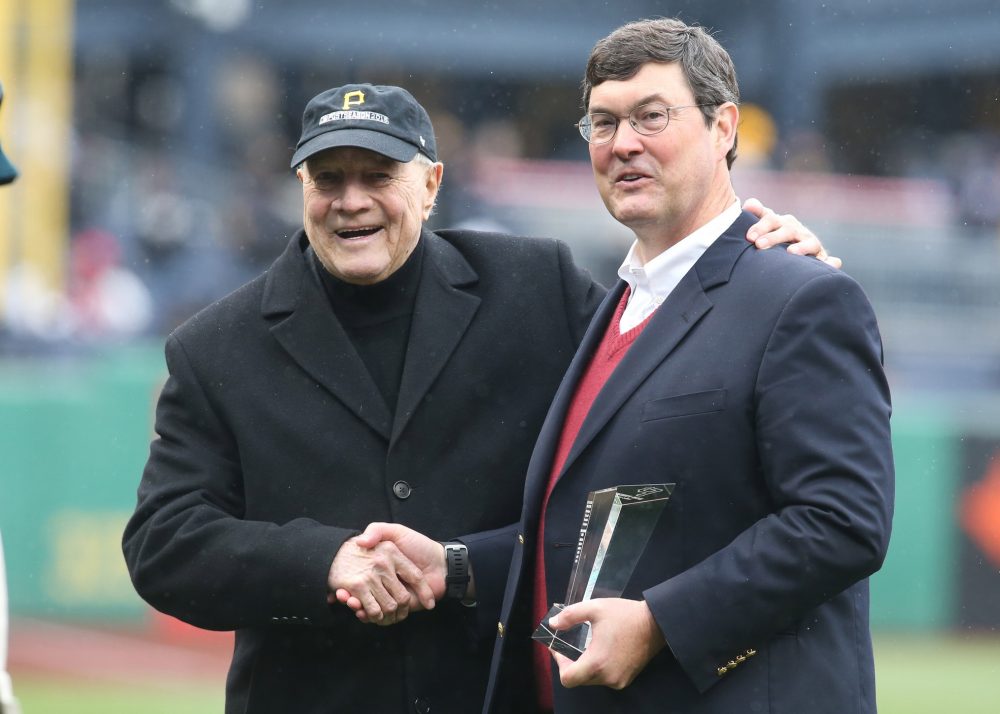
Asked Bob Nutting what it will take for #Pirates to break cycle of “develop, then sell when gets too costly.”
Answer: “I think you’d have a fundamental redesign of the economics of baseball, that’s not what we’re going to have.”#Pirates— Will Graves (@WillGravesAP) January 16, 2018
A while ago, I owned a nondescript Subaru station wagon. Great car, especially in the snow. Once a headlight burned out. I went to an auto parts store and bought a new bulb for $10 or $12. I took it home, looked up how to get the old bulb out, and put the new one in. I am not by any stretch of the imagination a do-it-yourselfer, so it took a little time and effort and scraped knuckles. But I got it done.
A while later, a friend of mine had a headlight burn out. She did not drive a standard transmission Subaru. Her car was, let’s say, a prestigious German brand. The headlamps were sealed, so she couldn’t replace the bulb. She had to bring her car to a mechanic. Getting a new headlight cost something like $350. It turns out that on her fancy car, in order to replace the headlamp, you have to remove the entire bumper.
I don’t mean to pick on Pirates owner Bob Nutting. At least not him solely. But his quote above represents a widespread misperception in contemporary baseball: That small-market teams like the Pirates can’t compete with the rich teams in New York, Los Angeles, and Chicago.
Let’s start with this: From 1947 to 1964—that’s 18 years—there were 109 World Series games. Of those 109 games, 45—or 41 percent—were contested between two teams from New York. Another 52—or 48 percent—had one New York team. There were only 12 World Series games over an 18-year span that didn’t include any teams from New York. And if you give New York credit for the California-transplanted Giants and Dodgers, you get 56 games with two current or recent New York teams, 47 with one, and only six games—Cleveland’s 1948 triumph over Boston—that didn’t involve Gotham. Long before free agency, the rich big-city teams absolutely dominated the game.
By contrast, during the 18 years since 2000, there have been only seven World Series games involving two New York teams (and that was back in 2000) and 24 involving one. The domination of baseball by teams in the biggest markets? It just isn’t happening. Look at the numbers if you don’t believe me.
This is not to say that all 30 teams are on equal footing. The Pittsburgh metropolitan statistical area had an estimated 2016 population of 2.3 million. Among MLB franchises, only Cincinnati, Kansas City, Cleveland, and Milwaukee are smaller. So the Pirates can’t draw from a population anywhere near as large as the New York (20.2 million), Los Angeles (13.3 million), Chicago (9.5 million), Dallas (7.2 million), or Houston (6.8 million) MSAs. (Fun fact: Miami is eighth, larger than Boston and San Francisco.) That means they can’t charge as much for tickets, their local broadcast rights are less lucrative, and there aren’t as many people who buy (oops, bought) Andrew McCutchen jerseys as Aaron Judge jerseys.
So yes, a franchise in a smaller community can’t draw on the same resources as one in a large community. But that’s only part of the story.
Pittsburgh receives revenue-sharing payments from teams in the larger markets. I couldn’t find exact figures, but an amount somewhere in the $20-$40 million range annually seems about right. In addition, all 30 teams will receive about $50 million this year from the sale of BAMTech (part of MLB Advanced Media) to the Walt Disney Company. Granted, that’s just a one-time payment (as opposed to the recurring revenue-sharing stream), but $50 million is, you know, like three McCutchens. Want to bet that the Pirates will not commit $50 million in free agent signings this year?
So yes, playing in Pittsburgh creates a structural disadvantage. But baseball has developed mechanisms—revenue sharing, the splitting of gate receipts, MLBAM—to mitigate that disadvantage. Forbes estimates the Pirates’ revenues at $265 million, a little more than half that of the Yankees. A disadvantage? Sure. Commensurate with the size of the respective markets? Absolutely not; not even close. Among the teams with lower estimated revenues than the Pirates are the Twins, Rockies, and Diamondbacks, each of whom snagged a Wild Card spot last year.
More importantly, as I’ve pointed out, buying a baseball team isn’t like other investments. The current ownership group (led by Kevin McClatchy; Nutting has since become the principal owner) paid $92 million for the Pirates in 1996. The owners could’ve done other things with that money. They could’ve built a hospital. They could’ve invested in a basket of no-load mutual funds. They could’ve bought shares of Microsoft.
But they didn’t. They bought a baseball team. You know why? The people who buy a hospital don’t regularly get interviewed by the Associated Press. Investors in mutual funds don’t get to walk through baseball clubhouses with family members and friends, and have famous athletes call them “Mister.” (As an aside, the spectacle of well-paid company employees referring to their employer formally instead of by his first name strikes me as one of the absolute creepiest aspects of sports.) If your shares of Microsoft are the best-performing stock some year, you don’t get to appear on national TV to receive a trophy.
Sports teams are not super investments. If they were, we’d see professional investors, rather than your basic really rich guys, buy them. They’re vanity purchases. You’re sacrificing economic returns in order to gain other benefits. There’s nothing wrong with that. All of us buy stuff we don’t really need because it gives us pleasure: A nice bottle of wine, an HBO subscription, a fancy car, a baseball team. A successful sports franchise can be part of a city’s identity, a real feel-good acquisition. But they’re like luxury cars. You’re buying them in large part for the non-economic intangibles that come with owning them.
For years, the Tigers had one of the highest payrolls in baseball. The Detroit MSA ranks in the lower half of baseball franchises. And the city of Detroit went bankrupt in 2013. You can’t play in a more challenging market than that. Yet the Tigers’ owner, the late Mike Ilitch, kept spending money on his team. He knew he’d made a vanity purchase, and he treated it as such.
Buying a baseball team and refusing to spend the money to make it competitive is the equivalent of buying a luxury car and complaining because it costs more than an $11.99 bulb to replace a headlight. You knew what you were getting into. If you didn’t want to have cash outflows, you could’ve spent your money differently. If you don’t want to pay up for star players, what’s needed is a re-examination of your motivations, not “a fundamental redesign of the economics of baseball.”
Next time, buy a Subaru.
Thank you for reading
This is a free article. If you enjoyed it, consider subscribing to Baseball Prospectus. Subscriptions support ongoing public baseball research and analysis in an increasingly proprietary environment.
Subscribe now
80% of baseball players come from CA, FL, AZ, TX, LA or the Dominican. NONE of them want to live in Pittsburgh, Cincy, Cleveland, Milwaukee due to weather and not being "home". That hurts these small market clubs severely because the big market clubs can out pay this weather/hometown deficit , small markets can't.