

Two months ago, the Oakland Athletics signed Eric Chavez to a six-year, $66 million contract extension that will keep him with the club through 2010. Despite some head-scratching from the public, there are good reasons behind why Billy Beane campaigned to do for Chavez what he hadn’t done for former MVP shortstop Miguel Tejada. Unlike Tejada, Chavez is a player whose skills, like his fine defense and his ever-improving plate discipline, are likely to be undervalued by the market. On top of which, Chavez has continued to demonstrate growth season after season, and PECOTA thinks that he’s a very safe bet going forward.
It is no secret, however, that Chavez has a tragic flaw: he can’t hit left-handed pitching. From 2001-2003, Chavez managed a stellar line of .306/.375/.579 against right-handers, but a Mathenian .229/.278/.395 against southpaws. The A’s, recognizing his defensive value and perhaps hoping that repetition would breed improvement, continued to start him anyway, in spite of a rotating array of viable platoon alternatives.
This year, indeed, has brought about a turnaround–Chavez is crushing lefties so far on the season (.288/.373/.561), while performing well below his career averages against righties (.214/.358/.398). Whether there’s any rationale for the change other than sample size, I’m not certain (I don’t get to see the West Coast teams play as often as I’d like to). What is clear, however, is that if such a change becomes permanent–if Chavez learns how to hit left-handed pitching at the age of 26–it would be a relatively unprecedented development. In most cases, a platoon split for a left-handed hitter is something like a finger print or a dental record: it remains a readily identifiable and more or less unchanging part of his profile throughout the different stages of his playing life. A left-handed hitter with a big platoon split early in his career is, in all likelihood, going to have a big platoon split later in his career.
Though most folks have been aware of the importance of the platoon advantage for a long, long time, the development patterns of left-handed hitters–particularly left-handed hitters who don’t hit left-handed pitchers very well–remains an under-explored subject area. As a result, I’m going to run a three-part series on the issue. Today, we’ll look at a sample of historical players, providing a narrative description of the progress of their platoon splits throughout their early and middle careers. In the second part of the series, to run next week or not too long afterward, we’ll look at the historical data in a more systematic fashion. I’d like to run a third part to the series, too, describing potential “solutions” to the problem, but that depends on how the second part goes. In the meantime, kids, grab a blanket and a Hi-C: it’s time for Southpaw Stories.
Retrosheet has comprehensive data on platoon splits available for each year from 1969 through 1992. There are about 35 left-handed hitters who had their age 22-30 seasons during the era, and who were major league regulars throughout most of that period. I randomly selected a sample of 10 such players to examine further. The lucky contestants are:
- Chris Chambliss
- Keith Hernandez
- Kent Hrbek
- Tony Gwynn
- Ruppert Jones
- Rick Manning
- Al Oliver
- Darryl Strawberry
- Jason Thompson
- Andy Van Slyke
Though the list was not cherry-picked for diversity–when I say something is random, I mean it: Nate Knows Random–it happens to contain a good mix of starts and scrubs, power hitters and slap hitters, short-career and long-career players. Let’s start from the bottom of the alphabet (there’s something uninspiring about Chris Chambliss, even years after the fact) and move upward, looking at each player’s platoon differential up until he hit the age of 30:
Andy Van Slyke
           OPS vs.
Year  Age  RHP LHP
------------------
1983   22  787 726
1984   23  720 745
1985   24  841 306
1986   25  854 643
1987   26 1012 650
1988   27 1005 558
1989   28  667 697
1990   29  893 730
1991   30  904 626
Even as his career was taking off–Van Slyke developed rapidly between the ages of 24 and 26, especially after being traded to Pittsburgh in 1987–his production against left-handed pitchers remained stuck in neutral. Indeed, if you look at Andy’s progress over time…
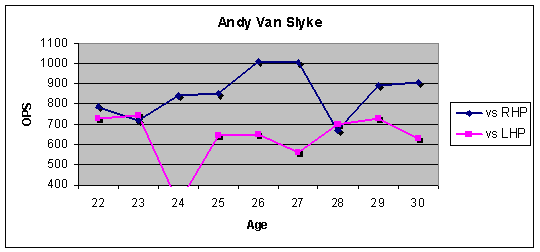
It’s almost as if you’re dealing with two entirely different players. One version, the one who plays only against left-handed pitchers, shows some promise out of the gate, but never really develops into anything, hanging on the big league fringe because he plays an OK center field and runs the bases well. The other version becomes a full-blown offensive star, with a peak at the usual ages of 26 and 27, and several productive years thereafter. This pattern, wherein a player’s development patterns against left-handed and right-handed pitching appear to be operating separately from one another, is a common one.
Jason Thompson
           OPS vs.
Year  Age  RHP LHP
------------------
1976   21  781 479
1977   22  998 639
1978   23  915 757
1979   24  793 629
1980   25  961 569
1981   26  908 865
1982   27  998 652
1983   28  821 666
1984   29  785 621
1985   30  758 724
Thompson was a slugger in the Adam Dunn mold: behemoth of a guy, reached the big leagues young, loads of walks and strikeouts, loads of power, sometimes struggled with his batting average. Unlike Dunn, who has posted surprisingly equivocal platoon splits, Thompson struggled mightily against left-handers. Making matters worse, he had the misfortune to be playing in a league in which the percentage of southpaw pitchers was very high–in 1978, for example, Thompson had more at bats against lefties than he did against righties. Save for a fluskish, 45 at-bat performance in 1981, Thompson’s ability to hit lefties never came.
Darryl Strawberry
           OPS vs.
Year  Age  RHP LHP
------------------
1983   21  889 714
1984   22  889 637
1985   23 1005 854
1986   24 1006 649
1987   25 1078 847
1988   26  930 878
1989   27 1012 650
1990   28  814 717
1991   29  890 881
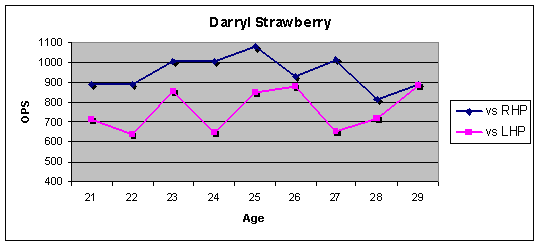
The Straw presents a more optimistic picture for Chavez. Although he always maintained a large platoon differential–the batting average, power, and plate discipline components of his line were all substantially diminished against lefties–there were some signs that his game against lefties was developing, as he posted an OPS of 847 or higher against them on four occasions prior to the untimely demise of his career (1991 was Darryl’s last full season).
Al Oliver
           OPS vs.
Year  Age  RHP LHP
------------------
1969   22  804 753
1970   23  775 646
1971   24  797 686
1972   25  810 738
1973   26  854 623
1974   27  877 752
1975   28  785 734
1976   29  878 764
1977   30  911 676
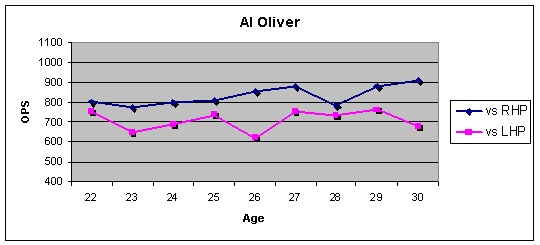
A remarkably consistent line-drive hitter, Oliver held his own against lefties throughout most seasons of his career, usually maintaining a “small” platoon differential of around 100 points of OPS. One question that we’ll try and answer in this series is whether some types of hitters routinely have larger platoon splits than others.
Rick Manning
           OPS vs.
Year  Age  RHP LHP
------------------
1975   20  775 557
1976   21  727 736
1977   22  712 389
1978   23  677 545
1979   24  669 522
1980   25  735 426
1981   26  722 527
1982   27  699 666
1983   28  672 518
1984   29  711 609
1985   30  545 650
Manning was a Tom Goodwin for the disco era–good defense, good speed, not much hit. If BP had been around back in the early-’80s, we probably would have made fun of him. Then again, there are unconfirmed reports that Gary Huckabay had a mullet back in the early-’80s.
In any event, lest it be thought that platoon splits are reserved for big, “one-dimensional” sluggers like Jason Thompson, Manning had one of the biggest platoon differentials of the bunch. While Manning’s development pattern was unusual–he had his two best seasons at ages 20 and 21–he was absolutely atrocious against left-handed pitching throughout his career, in spite of accumulating significant playing time for managers who thought highly of his defense and intangibles.
Ruppert Jones
           OPS vs.
Year  Age  RHP LHP
------------------
1977   22  843 639
1978   23  709 540
1979   24  819 758
1980   25  830 511
1981   26  721 605
1982   27  873 628
1983   28  790 355
1984   29  879 500
1985   30  796 625
Jones never hit lefties, but it wasn’t for lack of trying–he didn’t become a platoon player until the Padres wisely moved him into that role in 1983. Jones, who ran well and played a palatable center field, was always regarded as a multidimensional (e.g., “five tool”) player. Is it possible that managers are more reluctant to resign that type of player to a platoon arrangement than they would be a slow, chubby power hitter? In any event, his is another data point in the case against Chavez’ development.
Tony Gwynn
           OPS vs.
Year  Age  RHP LHP
------------------
1983   23  772 559
1984   24  918 724
1985   25  805 705
1986   26  814 907
1987   27  998 903
1988   28  833 716
1989   29  869 700
1990   30  831 680
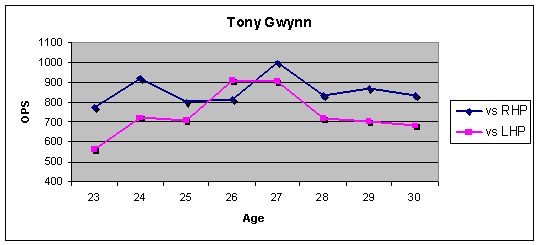
Gwynn was a remarkable player in many ways, including his ability to improve his performance against left-handed pitching–note the dramatic improvement from 1983 until 1987. While all the usual sample size caveats apply–it would be easy to make too much of a good run of a few hundred at-bats against lefties at the ages of 26 and 27–it might not be a coincidence that Gwynn was one of the most deliberate and hard-working hitters in the game, constantly reviewing tape and tinkering with his approach throughout his career. While Gwynn lost a little bit of whatever power he had against lefties, and drew fewer walks, he was able to maintain outstanding batting averages against them in almost every season.
Kent Hrbek
           OPS vs.
Year  Age  RHP LHP
------------------
1982   22  868 804
1983   23  863 838
1984   24  927 863
1985   25  829 726
1986   26  876 715
1987   27 1043 660
1988   28  974 715
1989   29  892 842
1990   30  891 734
It would be hard to conceive of two players who were closer to polar opposites than Gwynn and Hrbek–both had a little baby fat by the end of their careers, I guess.
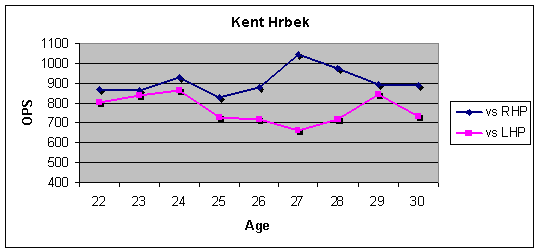
In any event, Hrbek started out well enough against lefties, posting small platoon differentials in his first three full seasons, before bottoming out against them during his peak; his is another case in which the two sides to a player’s batting line appear to be operating on separate tracks from one another.
Keith Hernandez
           OPS vs.
Year  Age  RHP LHP
------------------
1976   22  837 729
1977   23  813 880
1978   24  709 798
1979   25  944 908
1980   26  849 996
1981   27  948 713
1982   28  844 742
1983   29  867 745
1984   30  927 733
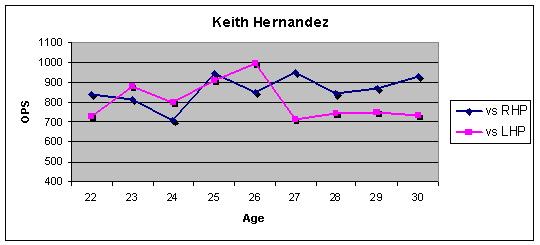
Hernandez was not an entirely dissimilar player from Chavez, and so his experience makes for an interesting precedent. Hernandez started out just fine against lefties–in 1977, 1978, and 1980, in fact, he put up a reverse platoon split. But in 1981, even though he had a full decade left to go as an All-Star caliber performer, Hernandez bottomed out against lefties and never recovered (if we extend the chart out a few more years, his platoon differential remains more or less the same). What triggered the change, I don’t know; Hernandez, though he might have gone through a few lifestyle changes over time, was a very consistent player throughout his career. But it looks to be statistically significant.
Chris Chambliss
           OPS vs.
Year  Age  RHP LHP
------------------
1971   22  795 662
1972   23  825 593
1973   24  797 584
1974   25  692 567
1975   26  831 663
1976   27  728 781
1977   28  843 700
1978   29  698 708
1979   30  866 624
Chambliss exhibits something of the opposite pattern to Hernandez: after struggling against lefties early in his career, he began to hit them notably better after being traded to the New York in the middle of the 1974 season. Chambliss was the first overall draft-pick in 1970, and the Indians did not platoon him early in his career despite his struggles–a move that might have been to their detriment, and the benefit of the Yankees.
* * *
I hope that was a worthwhile exercise; I haven’t looked at this sort of data before, and I suspect that most of you haven’t either. But it leaves us with more questions than answers: Most left-handed hitters display stagnant development against lefties throughout their careers, but what distinguishes the ones like Gwynn who break the mold? What about hitters like Hrbek and Van Slyke whose performance seems to regress against lefties? Does being platooned early in one’s career kill an individual’s capacity for development? Stay tuned for the next installment.
Thank you for reading
This is a free article. If you enjoyed it, consider subscribing to Baseball Prospectus. Subscriptions support ongoing public baseball research and analysis in an increasingly proprietary environment.
Subscribe now