

Three years ago, Joel Zumaya took the AL by storm, flashing an overpowering fastball on his way to a full season of stellar relief. Since 2006, though, he’s fallen on hard times. Now that the big righty has recently reclaimed his role in Detroit’s bullpen, let’s take a look at his prospects for future success by using all of the tools at our disposal.
Zumaya broke camp as a member of the Tigers‘ bullpen in 2006, after fellow rookie Justin Verlander had claimed a rotation spot in spring training. Except for a single appearance in relief as a 17-year-old in the GCL, Zumaya had worked exclusively as a starter in the minors, but his migration to the pen didn’t come as a complete surprise. Although Baseball America ranked him among Detroit’s top four prospects in each year from 2004-2006, talent evaluators frequently cited his intensity, max-effort delivery, inconsistent mechanics, limited repertoire (before 2005), and three DL stints (for back and shoulder spasms) as factors arguing for a shift to short relief work.
Zumaya’s performance in the pen for the pennant winners largely quieted concerns about his departure from the rotation, as he pitched 83
Zumaya’s body has been through a lot since those heady days. He became memorably unavailable during the 2006 playoffs as a result of a repetitive stress injury stemming from overuse of Guitar Hero and excessive autograph signing, and in April of the following year he tore a tendon in his right middle finger. Following the 2007 season, a 50-pound box fell on his shoulder, requiring career-threatening reconstructive surgery. Last August, doctors discovered a stress fracture in the same shoulder that may never heal, and he just recently returned from a DL stint for muscle cramps and shoulder soreness. In order to determine whether injuries have subjected his process to a decline as steep as that of his product, we’ll turn to Pitch-f/x.
Any mention of Zumaya begins (and usually ends) with his calling card: a blistering four-seam fastball, which regularly touched triple digits during his debut season. Zumaya wasn’t always a flamethrower-in fact, he fell to the 11th round of the 2002 draft out of high school because his velocity hadn’t yet spiked. Baseball America attributed his fastball’s subsequent boost in speed to refined mechanics and a 25-pound weight gain; Zumaya credited yoga and a daily long-toss program. Regardless of the true origin story of the pitch, Zumaya arrived in Detroit armed with a valuable weapon, and the fans took notice.
It’s difficult to say how hard he was actually throwing in 2006. During that season, the Pitch-f/x system measured start speed 55 feet away from home plate, a distance which has since been standardized to 50 feet, so the 99.0 mph average it reports isn’t fit for comparative purposes. However, BIS data from 2006 pegged his average fastball at 98.6 mph.
Year    FB     CB     CU
2007   95.6   79.9   85.5
2008   97.3   80.7   84.8
2009   98.0   81.2   84.8
After a dip in 2007, his fastball velocity seems to have returned nearly all the way to its former heights. It was an impressive recovery in light of the surgeries he’s undergone, but the days when a Zumaya appearance left radar gun-watchers breathless may be past, and thus far in 2009, he’s thrown 44 fastballs without cracking the century mark (though he’s topped 99 several times). Note the wide separations between the velocity of his heater and that of his off-speed stuff.
Let’s see how his outcomes and pitch results have changed throughout his career:
Year    K%     UBB%   SwStr% 100mphFB%
2006   27.7    11.4    13.1      N/A
2007   18.6    10.7     7.4     17.1
2008   19.3    15.8     8.2      8.4
2009   11.1     0.0     7.1      0.0
Zumaya has always walked too many batters (even in the minors), but as his strikeout- and swinging-strike rates have fallen, his unintentional-walk rates have climbed (until this year, in a small sample size). That’s a recipe for disaster. Later, we’ll try to determine what might be causing his control problems.


In each of the last two seasons, Zumaya has come out firing, but he hasn’t been capable of maintaining his velocity throughout his appearances. Of course, these graphs aren’t adjusted for park effects, and they include periods of injury, so the signal-to-noise ratio may be low, but it’s possible that his high-effort delivery takes a toll on his velocity over the course of a season. Even at his slowest, he’s still fast.
Before we examine how his pitches move and where they finish, we should pause to investigate where they begin. As a general rule, a delivery featuring fewer moving parts offers a reduced potential for failure; that principle applies to pitching mechanics nearly as well as it does to watches and hard drives. Until pitchers go digital, stable release points are the latest word in both design and deception. The more variables that a pitcher can control, the better; the plate may not move, but the strike zone and the catcher’s glove do, so if a pitcher can hold steady on his end, he’ll give himself the best chance of threading the needle.
We can see just how much noise might be present in this data, even in 2008, by comparing a graph of the release points for every pitch Zumaya threw last year to a graph of only those thrown at Comerica Park. Here’s the former:

And the latter:

You know what they say about baseball being a game of inches-restricting our sample to home games produces a substantial difference in the plot, and it eliminates the possibility that a wandering release point may be to blame for Zumaya’s control woes. He let fly with every one of his fastballs at Comerica last season within an area 9.96 inches wide and 9.25 inches high, and as you can see from the graph, the starting points for all of his other deliveries were also contained within those boundaries. Simply eyeballing the display suggests that he has little room to improve in this facet of his game, but I asked Eric Seidman to Check the Numbers, just to be sure. Here are the game-by-game standard deviations of both the horizontal (x0) and vertical (z0) components of Zumaya’s fastball release points last season, compared to the corresponding league figures:
         League       Zumaya
Year   Std.Dev.x0   Std.Dev.x0
2008       .17          .12

Year   Std.Dev.z0   Std.Dev.z0
2008       .12          .10
Despite the intensity of his delivery, Zumaya still manages to replicate the location of his release point better than the average pitcher. Shoulder injuries often cause pitchers to lower their arm angles in an attempt to reduce the strain on their weakened limbs, and even though Jim Leyland recently suggested that the “new” Zumaya might throw from a different arm slot, Zumaya’s release point does not appear to have fallen substantially at any time since the 2007 surgery that placed his career in jeopardy. We’ll have to look elsewhere for the culprit behind his control struggles.
Seen through the eyes of the Pitch-f/x cameras, the post-surgical Zumaya bears a strong resemblance to the uncut version before the release. How about after?

Remember, this view is from the catcher’s perspective. Imagine yourself crouched behind home plate, facing the mound, and you should be properly oriented. A “spinless” pitch would fall directly on the intersection of the two axes, making the journey from hand to glove without any lateral movement, and sinking only to the degree dictated by the force of gravity. A data point above the horizontal axis represents not a pitch that rose (no pitches actually do), but a pitch that fell less than would have been expected, had it been acted on by gravity alone. Because fastballs and changeups are thrown with backspin, the Magnus Effect exerts an upward force on the ball, producing the illusion of a rise (hence the term “rising fastball”). Curveballs, thrown with topspin, experience a similar impetus oriented in a different direction, and sink more than they would if they were thrown in a vacuum chamber. Pitches to the left of the vertical axis moved in on righties (and away from lefties), and pitches to the right of the vertical axis moved in the opposite direction. This doesn’t mean that any individual pitch depicted here necessarily finished inside or outside, just that it moved in the indicated direction while in flight.
The markers in the upper-left quadrant represent Zumaya’s fastballs and changeups, which move in toward righties and sink less than our theoretical spinless pitch would; those in the bottom-right quadrant represent his curveballs, which move away from righties and sink more than gravity alone would dictate. Not only does he possess significantly above-average velocity with all of his pitches, he also boasts impressive movement. His fastballs this year have moved an average of 8.0 inches toward right-handed batters, compared to the major league average of 6.0 inches; last year, his fastballs moved an average of 6.5 inches (and 7.0 inches in 2007). While the improvement could stem from this season’s small sample size, any lasting gain in movement would help to differentiate Zumaya even further from the passel of straight throwers populating major league mounds. Given his velocity, he might be able to survive with a Scott Proctor-like fastball break, but, as the saying goes, most major leaguers can catch up with the fastball, provided they know where it’s going. His opponents may not be privy to that information, but unfortunately, there are times when Zumaya himself is only slightly better-informed.
Let’s take a graphical look at the movement on Zumaya’s pitches this year, compared to the corresponding offerings from the previous two seasons. Again, we’ll limit ourselves to his home park in order to minimize distortion. Sportvision didn’t track pitches at Comerica Park in the 2006 playoffs, so we’ll have to be content with data from 2007-2009.


Key takeaway here: the man throws very few of these. More on that later.

Zumaya’s curve actually moves slightly less toward lefties than the typical deuce (though that ’07 outlier adjacent to the y-axis may be skewing his average). However, he ameliorates his deficiencies in the lateral department with above-average descent: his curve sinks one to two inches more than the league-average yakker. Moreover, Zumaya’s curve typically hovers between four and five mph above the league average of approximately 77 mph; even when it’s not moving substantially more than the offerings of most other pitchers, it’s arriving at its destination more quickly (and with roughly 16 mph of separation from his fastball, it’s an essential component of keeping hitters off-balance). This sequence of graphs reveals that Zumaya hasn’t lost much, if anything, in the movement of his pitches, despite his on-field struggles and off-field ouchies.
The following flight-path displays (calculated by using observations of release point, velocity, and acceleration) give us a better idea of how Zumaya’s pitches in 2009 would have appeared to observers from three different perspectives:

Were a tardy ceremonial parachutist to come swooping into Comerica just as Zumaya delivered a pitch, this is the view he might see (of course, he’d likely have more pressing concerns). Each tick mark on the trajectory lines represents a 40-millisecond time interval; if you study them closely, you can see that the tick marks on the fastball line are set further apart, which reflects the greater velocity at which his average fastball traveled as compared to that of his average changeup (and, by extension, the greater distance covered by the average fastball in each 40-millisecond interval).

This perspective allows us to see the “hump” on the curveball very clearly, but notice how closely Zumaya’s fastball and changeup paths mirror each other until diverging roughly halfway to the plate. Some research suggests that batters require approximately 0.2 seconds to make their decisions about whether to swing, and an additional 0.15 seconds to carry out the action. Given the speed at which pitched balls travel, batters must commit to swinging well before the pitch enters the range of their lumber. The later the pitch breaks, the less likely it is that the batter will be capable of anticipating and reacting to the movement.
Here’s one final look at Zumaya’s flight paths, this time seen from the catcher’s perspective:

Now that we’ve determined how fast his pitches go, where they start out, and how they move en route to the plate, let’s take a look at where they end up. Again, we’re viewing the pitches from the catcher’s perspective, but this time the scale is in feet, rather than inches. The box in the center represents a typical strike zone as called by umpires and respected by batters-of course, the actual boundaries of the zone vary by hitter (a factor accounted for by the Pitch-f/x system).


His pitch plots are awash with blue; he throws the fastball with remarkable regularity (we’ll see how often in just a minute). He likes to work down and away with his curve against righties, hoping to entice weak swings and misses. With a righty in the batter’s box, he becomes a two-pitch pitcher, and in fact he’s thrown only one changeup to batters of his own handedness since 2006, a 2-2 delivery off the inside corner to Mike Piazza. In 2007, Zumaya held righties to an anemic .135/.247/.203 line, but last season they tagged him to the tune of .317/.406/.533. This was likely nothing more than a statistical fluke, but he also appears to have thrown a greater percentage of his fastballs over the center and inside corner of the plate to right-handed batters last season.


Although Zumaya peppers the heart of the plate with his heater against righties, he takes a more cautious approach with southpaws, staying away and up in the zone. This heightened tendency toward nibbling has contributed to a career 13.6 percent unintentional walk rate against batters of opposite handedness, compared to his 10.7 percent UBB rate against righties. While Zumaya mixes in the occasional changeup against lefties, it almost never ventures into the strike zone.
If you have an ESPN Insider account, you can examine how closely the Pitch-f/x data matches up with Inside Edge’s scouting report on where Zumaya likes to work (just remember to adjust your mental perspective, since the Inside Edge strike-zone plots are presented from the pitcher’s perspective, rather than the catcher’s).
Let’s examine the locations of Zumaya’s pitches in another graphical form, borrowing the terminology and methodology pioneered by Harry Pavlidis at Cubs f/x. On the vertical placement graphs, “High” and “Low” denote balls; “Up” denotes balls in the upper third of the strike zone, while “Middle” and “Low” denote balls in the middle and lower thirds, respectively. On the horizontal placement graphs, “Tight” and “Wide” represent balls; “Fat” encompasses the middle ten inches of the strike zone, while “In” and “Out” include balls in the outer seven inches of each edge of the zone. You may have noticed that these horizontal strike-zone dimensions sum to a width of 24 inches, while home plate is only 17 inches wide. Empirically, both hitters and umpires tend to observe a wider zone than the theoretical model, counting 3.5 inches off each edge of the plate as “close enough.”


Zumaya doesn’t hesitate to run either his fastball or his curveball over the heart of the plate, but he almost never throws his changeup anywhere but off the outside corner. Granted, Max Marchi recently found that the outside corner is the only location where a pitcher can regularly expect a positive outcome with his changeup, but Zumaya might be better-served by going to that well more often. Again, more on that ahead.
The strike-zone plots gave us a general idea of Zumaya’s pitch distributions, but let’s take a closer look:


He loves the fastball; last season, he traded a clump of curveballs for even more heaters, using his tertiary stuff sparingly. Like the Terminator, Gameday utilizes a neural-net processor; the more contact it has with humans (specifically, the pitches they throw), the more it learns. Thus, the “unknowns,” which Gameday classified as sinkers and sliders, could simply be curves with unusual break which deceived the system. Most of them feature relatively low confidence ratings, which is Gameday’s classification algorithm’s way of saying that its testimony might not hold up under cross-examination.
Let’s break this down further:


As mentioned above, Zumaya threw nary a changeup to righties in 2008; he threw only one while facing them in 2007. John Walsh found that pitchers tend to throw changeups three times more often when facing opposite-handed batters, but Zumaya’s changeup platoon split easily surpasses that ratio. In his essay in The Hardball Times Baseball Annual 2008, Walsh also found that the changeup is actually relatively “platoon-neutral,” suggesting that pitchers would likely be better served by utilizing the changeup more often against batters of identical handedness. As we’ve seen, Zumaya’s change-of-pace features a release point and movement similar to those of his fastball, and boasts an impressive speed differential from his number one pitch; in other words, the ingredients for an effective pitch are present. In this case, the numbers jibe with the scouting reports (though Pitch-f/x data could be considered a hybrid of the two)-prior to the 2006 season Baseball America rated his changeup as the best in the Tigers’ organization, one that includes both Justin Verlander and Fernando Rodney, two fellow flamethrowers who utilize their changeups far more often than Zumaya.
So why hasn’t he thrown it more often? A number of factors could be to blame. For one thing, Zumaya developed the pitch fairly late in his minor league career, and players tend to stick with the approaches which have served them well in the past. It could be that he’s only following orders-perhaps he was instructed to focus on only two pitches after his transition to the bullpen-or it may be that his love affair with the radar gun has led him to spurn the slower stuff, though Jason Beck, who covers the Tigers for MLB.com, strongly discounts that possibility, as a result of Zumaya’s frequent acknowledgement of the importance of pitch-mixing. Finally, it’s possible that there is some organizational bias at work: the Tigers currently have the seventh-lowest changeup percentage in the majors, and finished with the third-lowest last year (of course, that could simply be a byproduct of the staff’s composition).
Let’s take a look at two brief sequences in which Zumaya utilized his oft-neglected changeup to his benefit. Last July 19, Zumaya was called upon to close out the Orioles at Camden Yards, entering the game in the bottom of the ninth with a 10-9 lead. As usual, he struggled with his control. After a game-tying homer, two strikeouts, a walk, and an infield single, Aubrey Huff strode to the plate, with two outs and the winning run on second.

Zumaya started Huff off with his favorite delivery to lefties: a high, hard, outside four-seamer. He followed that up with another fastball, this one lower, but even farther from the outside corner. Rather than choosing to pump yet more gas in Huff’s general direction, Zumaya took something off (roughly 11 mph, to be precise), steering a changeup to almost the exact same spot as the previous fastball. Huff, geared up for the fastball, rolled over and pulled the ball to second base for an easy out.
Here’s a more recent example, drawn from last Saturday’s scoreless outing against the Indians:

With two outs and Ben Francisco on first, Zumaya started Sizemore off with three straight heaters. Sizemore swung through the first pitch and fouled off the next two, though the third was fairly well struck. Had Zumaya chosen to quadruple up, Sizemore might have timed his offering; instead, the righty delivered a changeup that whispered across the outside corner, as Sizemore stood and stared. Quoth Zumaya, once the dust had cleared: “That’s a good moment to throw it, when the guy’s sitting dead-red. I can also throw the breaking ball, but he hasn’t seen the changeup, so it’s a good place to throw it.” If he has truly learned that less is often more, there may be a return to form in store for him in 2009. Caution is in order, however; while Zumaya may have refined his changeup this spring, the neglected pitch was a viable option long before this season, according to both Baseball America and the Pitch-f/x data.
Now, allow me to echo Joe Sheehan‘s familiar refrain: I Am Not a Scout, and I’d hesitate to suggest that my untrained eye could detect a flaw which had eluded the professionals. Still, in certain cases, adding a dash of ocular analysis to your number-crunching broth can really get the analytical stew going. Whenever possible, it’s useful to suggest a potential solution to a problem, rather than simply noting that it exists. Take the following with a grain of salt, but here’s one potential explanation for Zumaya’s habitual wildness.
While studying Zumaya’s delivery, E-migo Drew Samuelson from Pacific Prospect Report and I noticed that Zumaya’s landing foot points roughly ten degrees outward (toward the lefty batter’s box) after coming to rest. If you’d like to see for yourself, watch this video (sorry about the quality), or take a look at these still photos here, here, and here. In addition to noticing Zumaya’s fickle taste in facial hair, you should be able to spot the podiatric problem.

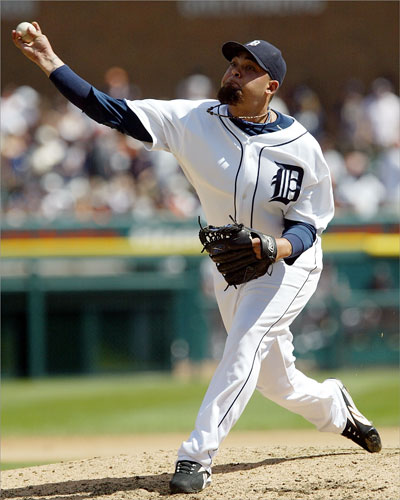
With that observation in hand, I spoke to Dr. Glenn Fleisig at the American Sports Medicine Institute to determine the effects of such an alignment. According to ASMI’s testing, the “elite range” for a stride foot’s landing extends from three to 24 degrees in an inward direction (toward the righty batter’s box). An outward-facing foot may cause inconsistent mechanics (and their associated control problems), as well as potential injuries down the road. According to Dr. Fleisig, “The purpose of the front leg is to consistently catch yourself, brace yourself, and let your whole body, including your leg, come forward.” If you’re feeling chipper, stand up and follow along (especially if you’re reading at work). Go into the pitching motion you practiced in front of the mirror as a youngster, and land with your foot pointing inward. Now, without moving any other body part, swivel the foot in an outward direction, so that it resembles Zumaya’s. Doesn’t feel so good, does it? In fact, it almost hurts. Now imagine that you’re landing with all of the momentum of a 6’3″, 210-pound hurler descending from a major league mound.
Dr. Fleisig explained that in a situation like this, the knee either does its job and braces the pitcher despite the added strain (which could lead to knee problems), or the knee fails to do its job, and transfers some of the stress to the arm (which can lead to even worse trouble). The Tigers could work with Zumaya to straighten the stride foot, but they must be wary of provoking corresponding changes elsewhere in the chain; as Dr. Fleisig noted, “It’s not just the foot-the pitching coach has to work with the whole pitcher.” Zumaya may have more serious flaws from an injury perspective, but the foot issue could be partially to blame for his poor control.
The good news here is that Zumaya appears to have retained most of the arsenal that he possessed when he first appeared in the majors; the bad news is that his 2006 performance was not sustainable. However, Zumaya is still only 24 years old, and a slight alteration in approach could unlock his full potential. A reliever doesn’t need three pitches to be successful-in fact, in 2004 Baseball America said that “His approach, power stuff, and lack of a changeup [emphasis mine] could make him a closer in the long run”-but while his raw stuff may be relief-ace worthy, his usage and placement of it has not been. Look at the list of relievers with double-digit save totals last year; very few sport walk rates rivaling Zumaya’s, and those who do either strike out more batters than Zumaya has at his best (Brad Lidge and B.J. Ryan, in their good years), or make substantial use of a third pitch (Francisco Rodriguez, Francisco Cordero). Of course, Zumaya can give the likes of George Sherrill and Kevin Gregg a run for their money without changing a thing, but Detroit’s beleaguered bullpen, which finished 29th in the league in both WXRL and FRA last season, needs something more than mediocrity. If Zumaya hopes to indulge his dreams of closing, becoming the first Tiger to rack up 20 saves with a FIP under 3.5 since Matt Anderson barely accomplished the feat in 2000, he might be wise to do some tinkering.
Thanks to R.J. Anderson, Harry Pavlidis, and Eric Seidman for their assistance.
Ben Lindbergh is a contributor to Baseball Prospectus and a student at Georgetown University. You can contact Ben by clicking here.
Thank you for reading
This is a free article. If you enjoyed it, consider subscribing to Baseball Prospectus. Subscriptions support ongoing public baseball research and analysis in an increasingly proprietary environment.
Subscribe now