


I don’t know what your experience with the word “rubric” is. Maybe you went to school when you just got a score for an assignment and a scant explanation for it. Maybe you got a score with a bunch of numbers out of certain other numbers that all added up to 100. Maybe the word evokes a sense of corporate confusion or dismay, the way Liz Lemon reacts to hearing Jack Donaghy speak of synergy.
For me, it levels the field. I show it to students ahead of time, walk them through it to see how it breaks down, and ultimately say “this is what I expect.” It contextualizes skills we’re working on and uses mostly plain language, while providing an objective point of reference for performance and improvement.
There are any number of rubrics out there for reference and like anything they go in and out of style. One straightforward rubric that attained wide-scale use was the series of Common Core rubrics, which split the four high school grades in half, 9-10 and 11-12. They’re aligned with standards that set bars for students to reach by the middle of their four years and at the end of them. There are slightly different versions of it based on what kind of writing is required: argument, informative, and narrative. Here’s the one for narrative writing:

If you’d like to zoom in more freely, or see the modest differences between types of writing, you can do that here. Maybe you noticed that it’s scaled from 5 (you crushed it) to 1 (you submitted something). Conveniently, there are five letter grades: A (huzzah!), B, C, D, and F (sad face, question marks, concern, a call home). This particular rubric is designed to be holistic, which basically means there is wiggle room to consider the student and their effort rather than just giving them a score as if numbers are immutable. When I use it, I think of each box in three phases. A mark on the far left of a box would be about a grade-plus—A+ execution, or B+, or what have you. In the middle would be that grade squarely—an A, a B, and down the line. On the far right would be a minus—A-, B-, and so forth. A mark right on a line between two typical grades would be a 90, 80, and, well, you get the idea. Then I average them and give a score, plus or minus a little bit because of that holistic bit. As I go through an assignment, I’ll leave comments on certain sections so no one is confused about how or where the feedback can be applied.
Now you know a part of my day-to-day that is both inane and critical. And now you’re going to see how I’d grade MLB’s Jackie Robinson press release for 2025. We’re using the narrative rubric because more than anything baseball is a game of moments and stories. Given its decades and decades of existence, the league has a vast amount of resources to pull for reference. The league has been witness to the work for more than a century. It should have a good sense of how to construct an effective story for one of its biggest figures, and the assignment shouldn’t be that difficult. So how’d they do? Below are screenshots of the press release, with bullet point notes on each.
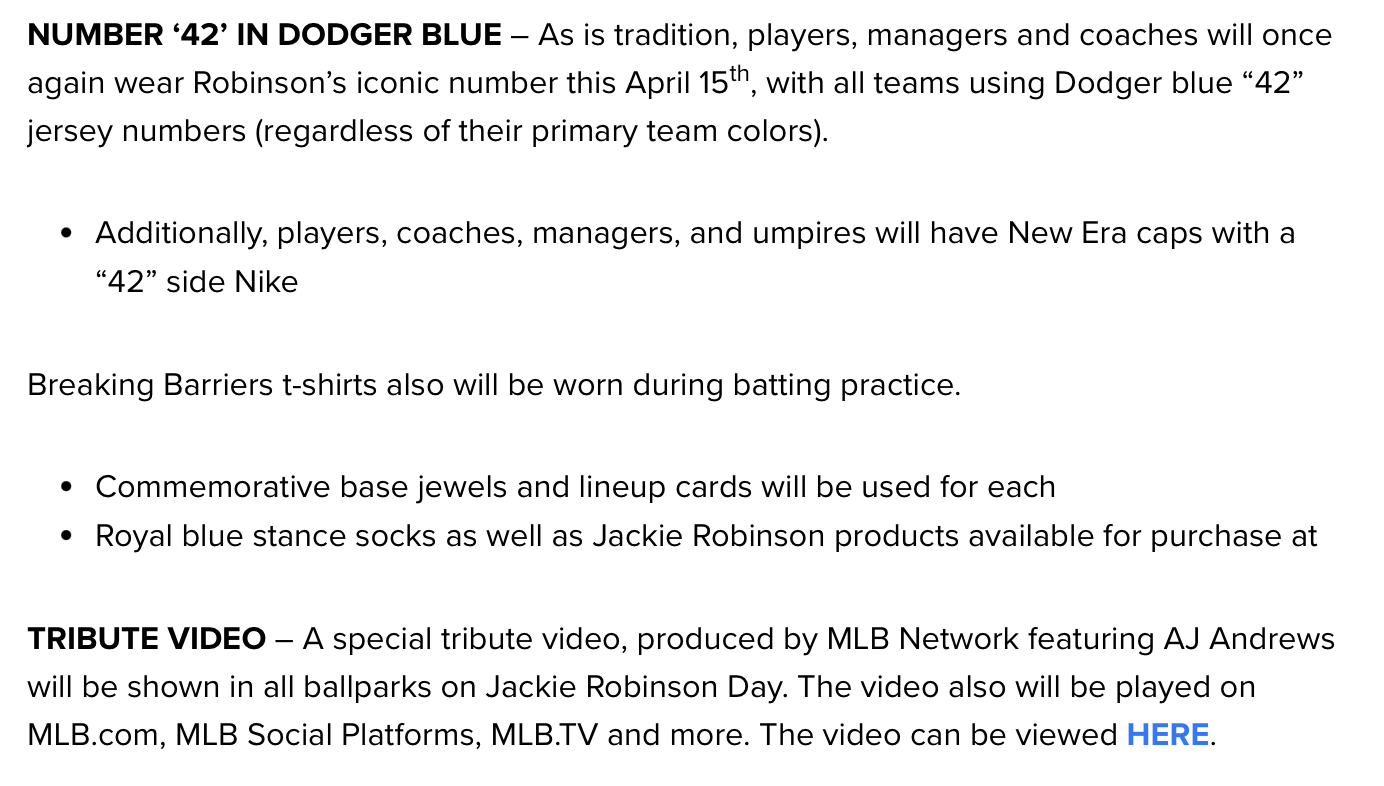
- Cool notes—wearing 42 means anyone watching will know something’s up.
- T-shirts are…useful? I know pulling a Michael Scott Fun Run shirt isn’t exactly good design, but this release is a good space to expand on what “breaking barriers” means in this context. Even a half sentence would help, something like “to commemorate Jackie’s breaking the color barrier” or even more slogan-like, like “he did, we can”
- Do you know where the Jackie Robinson products could be purchased? Feels like something you’d want people to know, but the sentence ends abruptly with no resource.
- Same could go for AJ Andrews—you can’t assume everyone will know she was the first woman to win a Gold Glove, or even that she was a pro softball player.

- Cool! What will be in the hygiene kits? Was Robinson connected to any particular volunteer efforts or similarly minded causes? His playing career ended ahead of the Civil Rights Movement, which could maybe speak to the spirit of a volunteer effort.
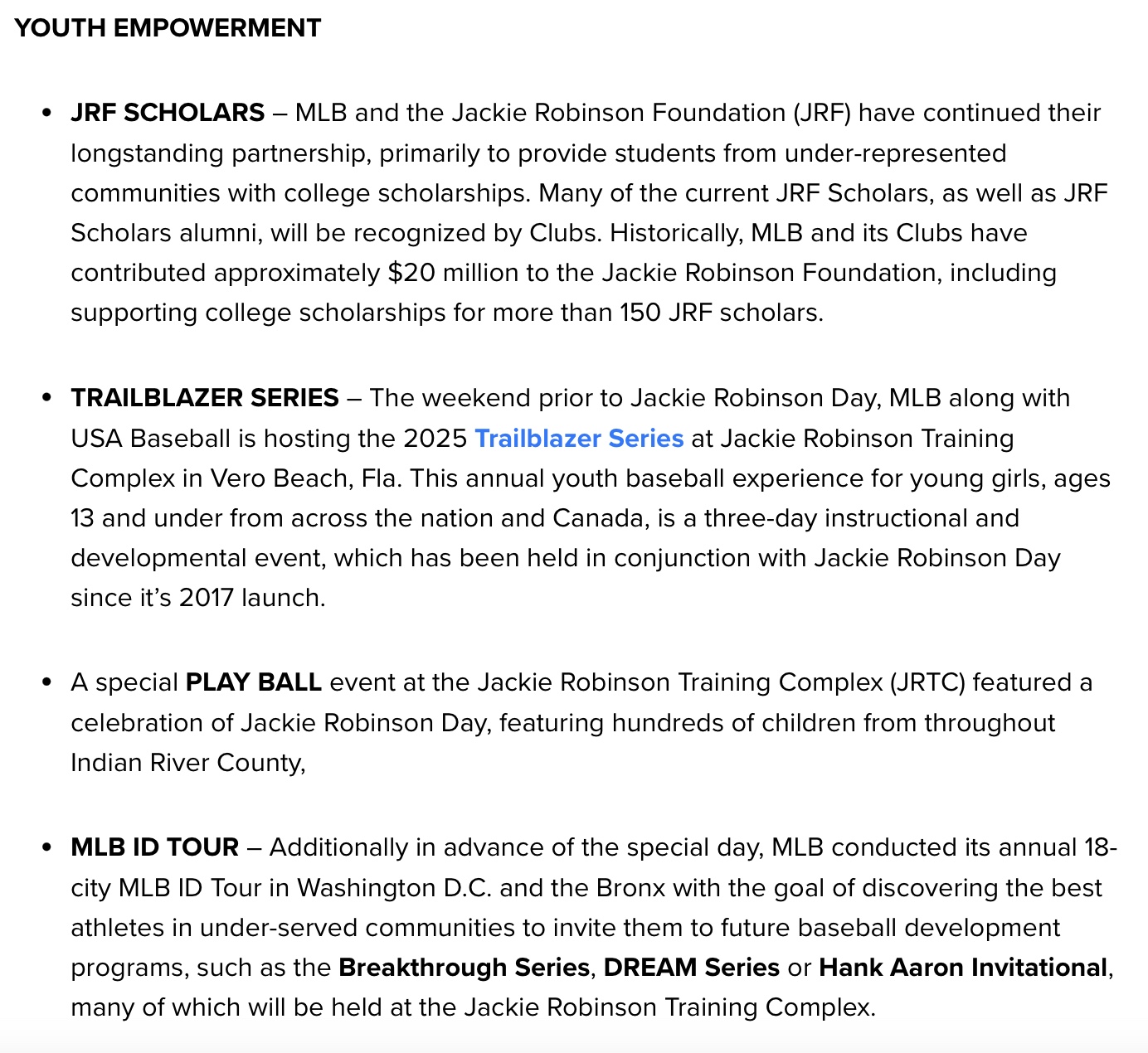
- Why is the Trailblazer Series in Florida? Why is the complex named after Robinson? He played for the Dodgers, who were based in Brooklyn at the time—does it have anything to do with that?
- If so, is there a value you could speak to about maybe keeping a tradition alive or something?
- Ok, so you’ve gotten at this a couple of times already, but you say it outright here. What makes it a “special” day?
- A lot of the programs you’re mentioning so far seem to be about increasing not just awareness, but equality for people who are overlooked. Is there a reason these people are overlooked? Does any reason potentially speak to the volunteer work you mentioned above?
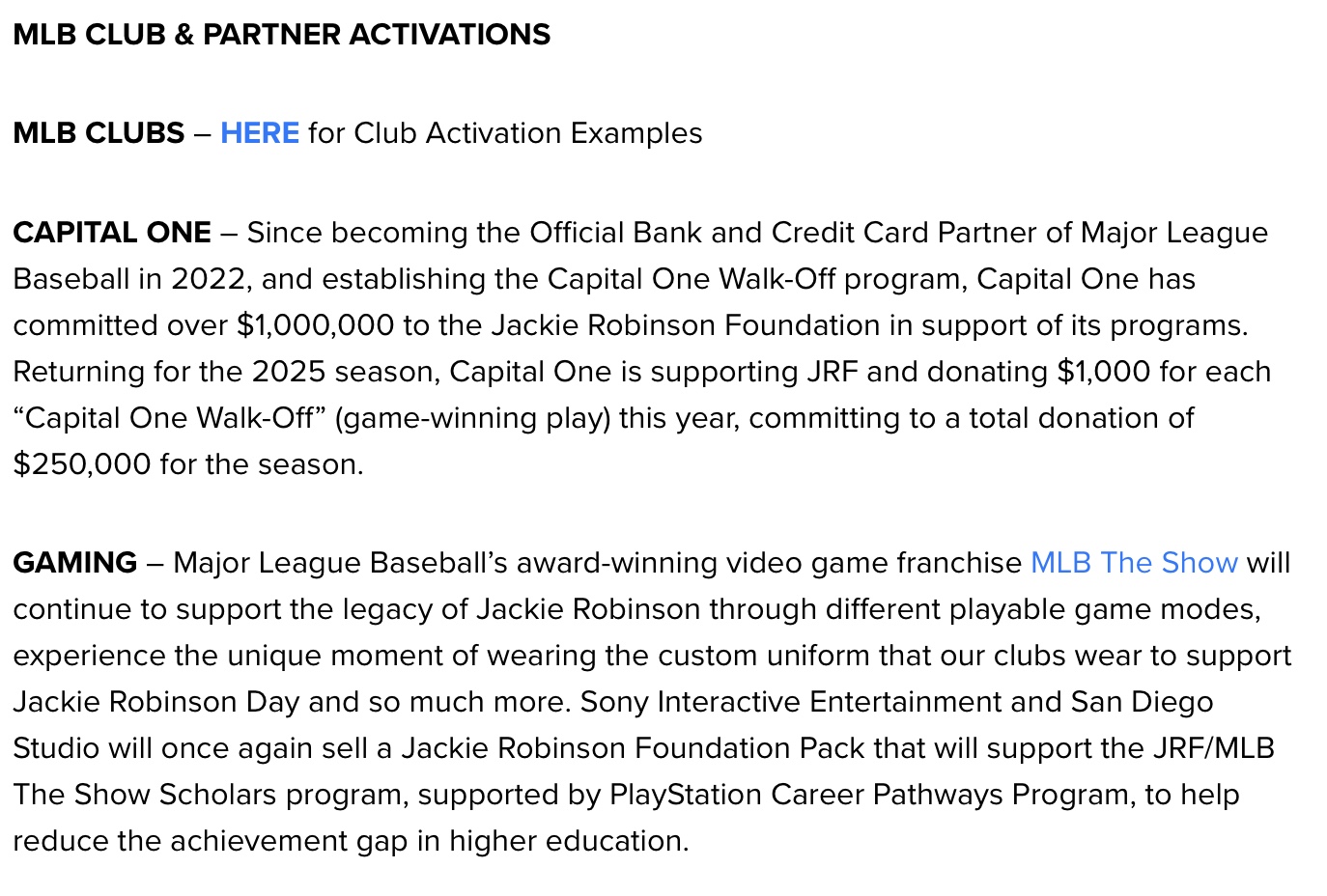
- “Club Activation Examples” is confusing. Are these suggestions for the teams, like an internal thing? The Google Doc you linked seems like each team’s actual plan for the day. That seems worth incorporating directly.
- Awesome note on Capital One, that’s a lot of money. Do you have examples that are especially noteworthy that you could share, based on the previous $750,000 in commitments?
- What kind of success have Sony and San Diego Studio had selling this Foundation Pack?
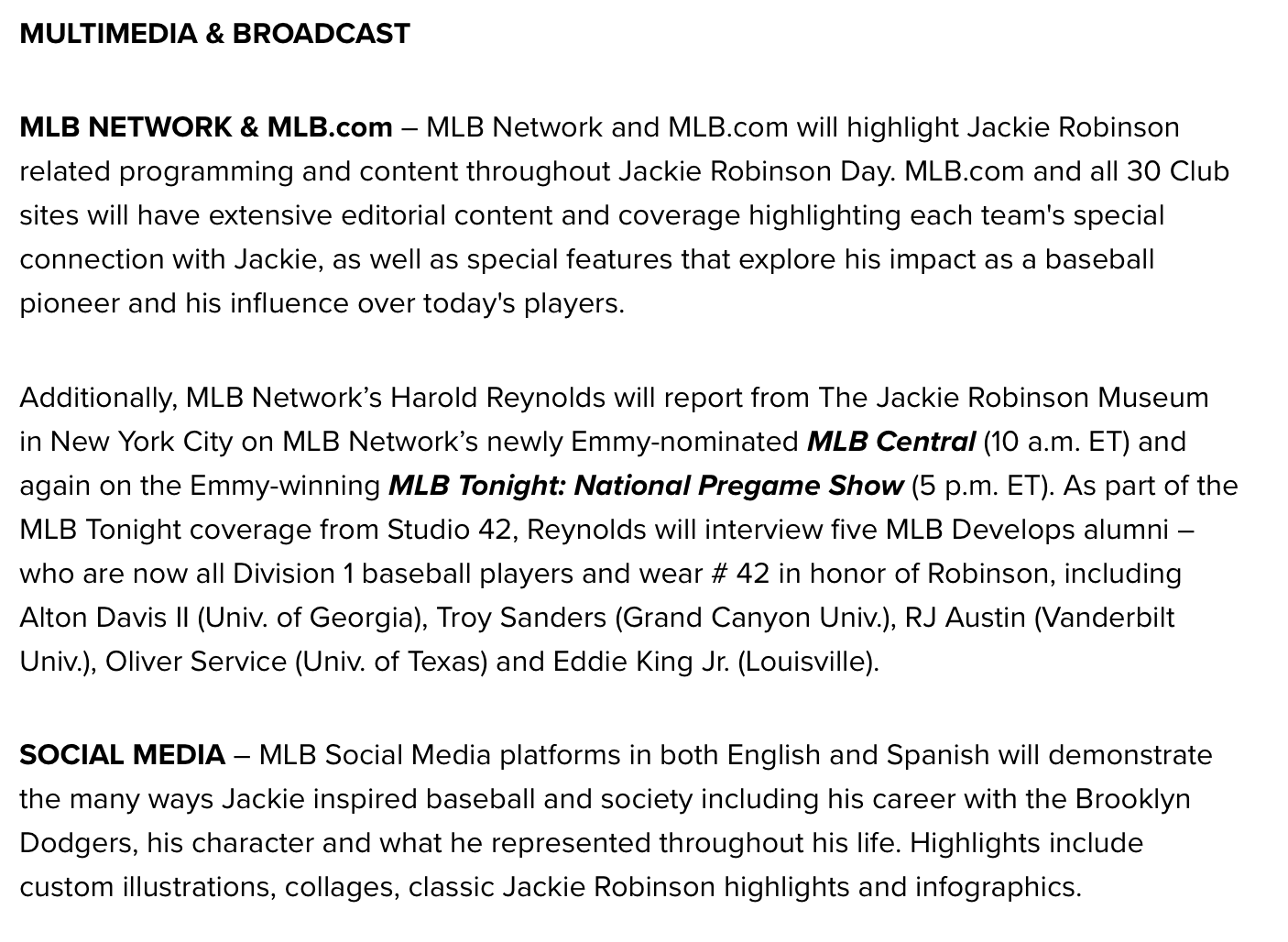
- This broadcast stuff seems really cool. Is it something that gets incorporated all year, like a mission statement? Or is it only highlighted annually?
- Pretty sweet to acknowledge some of the bigger successes from MLB Develops. Looking forward to that part.
- Gotta say this again: You say outright that Jackie inspired baseball *and* society in a life-long, but don’t mention how. What, exactly, did he do? Very few people get this much recognition for their life, let alone someone who’s been dead for 50 years. Feels like it would be an easy thing to bring up, given how much focus you’re putting on him?
- How do art/highlights/infographics highlight his work? I’m with you, that stuff is super important. What does it combine to offer that words alone can’t?
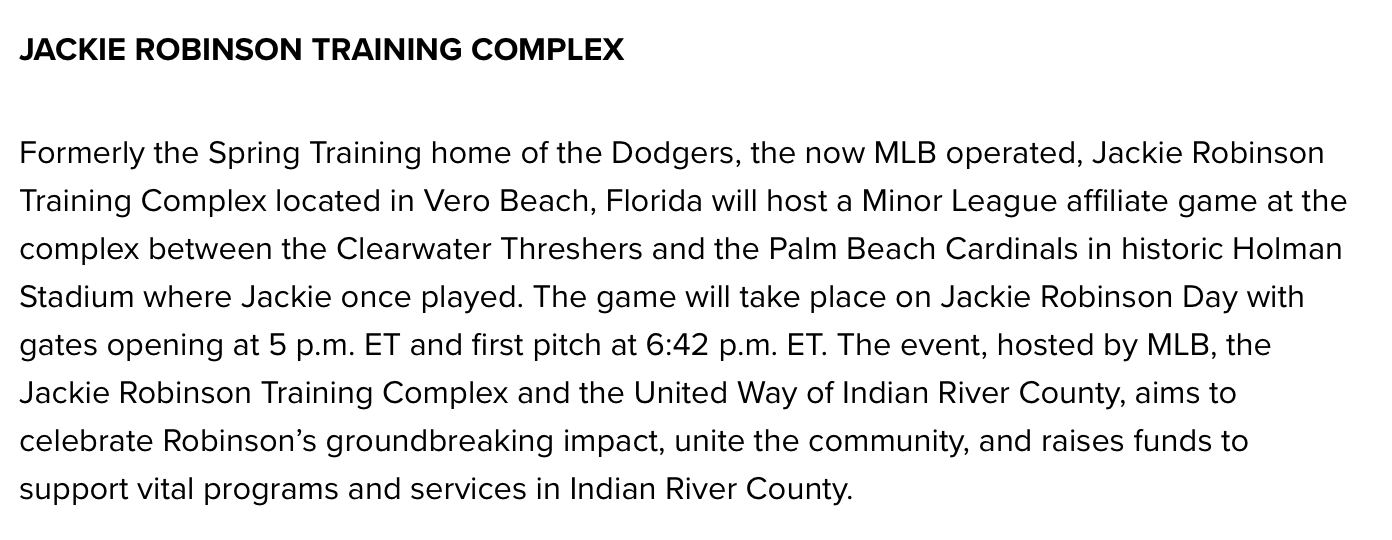
- Ah, ok. Vero Beach is important because Robinson did play there. Got it. Glad you mentioned it, but saying it sooner would be more helpful for your readers.
- First pitch at 6:42 is a little on the nose.
- Ok, so he inspired baseball *and* society with a groundbreaking impact—what was it? Can’t take for granted that your readers understand as much as you might.
- What programs and services are these? Are they related to the volunteer work, or the way Robinson was groundbreaking? Is that what makes them vital?
Generally, the more comments I have to leave are commensurate with the amount of room there is for improvement. There are 19 comments above so you probably have a sense for where this is going, but let’s take a look through the lens of the rubric:
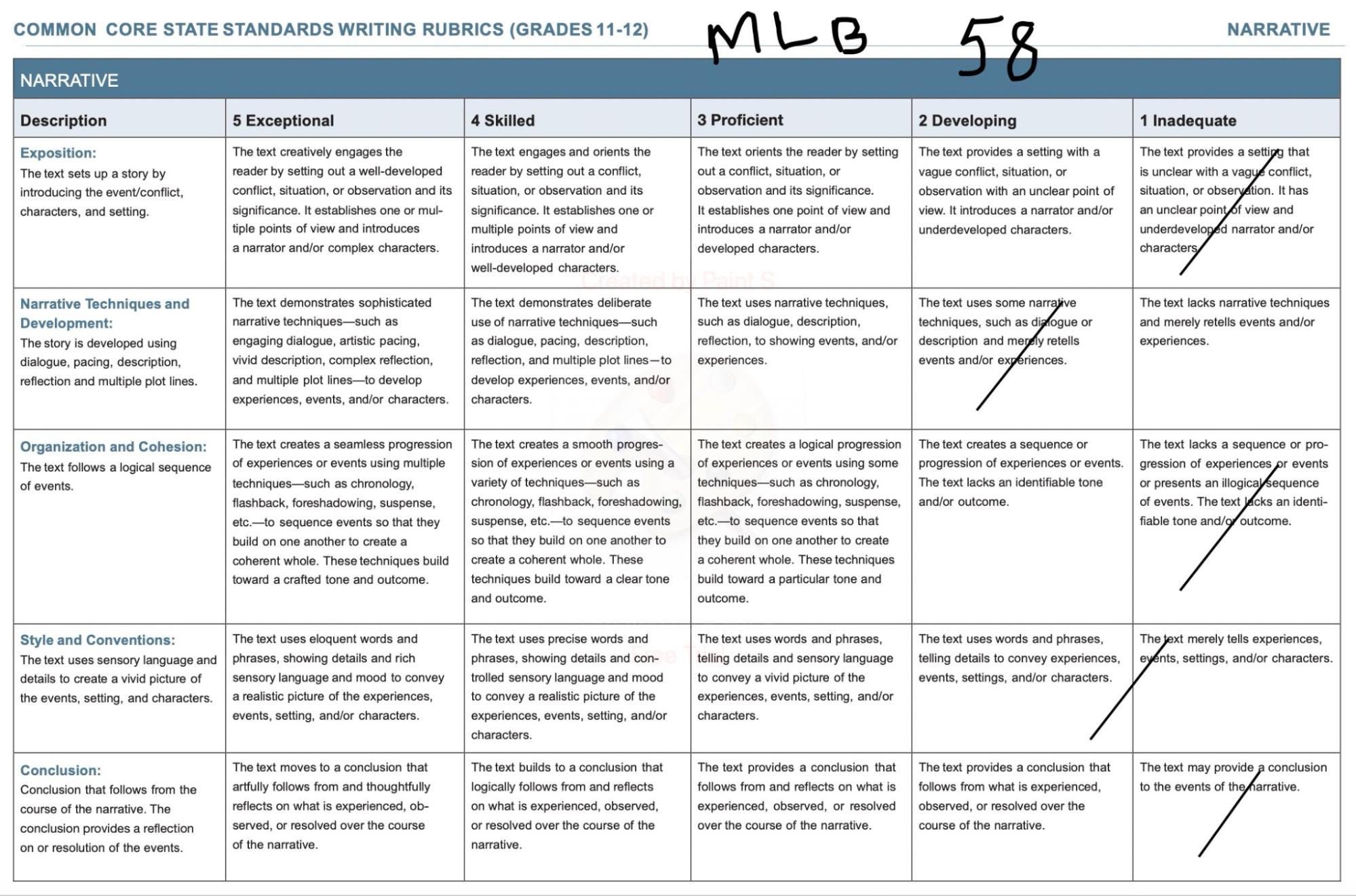
It can be difficult to create compelling information on the same topic every year. However, the challenge is also an opportunity for creativity. Instead, MLB fell short of communicating even the most basic actions Jackie Robinson ever took, let alone the depth of his convictions. They had a year to plan since last time. They’ve been celebrating this day for more than 20 years. The groundwork was there for them to succeed. The thing about blown assignments like this is the framework is almost always present in the final product. Even a half sentence more in each section could have offered so much insight; taken it from a clear failure to a gentleman’s C. What’s turned in is a matter of how much the student cares, or how much they consider the bare minimum.
It’s not just a matter of the league having fatigue with one of its most important figures, which would be embarrassing enough. In 2024 the same press release included explicit information on each team, instead of linking to a poorly framed Google doc. In 2023, it dared to mention “diversity,” which it has since removed from any initiative and hasn’t acknowledged. A press release will never say everything. Really, its function is to only say good things. The way MLB tries to pass off the life and impact of Jackie Robinson at this point is like a kid handing in a paper for a book they didn’t read, though. And when called on it, they often react the same way: with an admitting silence that refuses to acknowledge their participation, and waits only for the moment to end.
You can learn more about Jackie Robinson—and what MLB left out—through his BP player archive.
Thank you for reading
This is a free article. If you enjoyed it, consider subscribing to Baseball Prospectus. Subscriptions support ongoing public baseball research and analysis in an increasingly proprietary environment.
Subscribe now