

I remember reading an article as a college student that described how Randy Johnson had made a mechanical adjustment that allowed the large lefty to extend his release point by more than a foot. The sheer thought of the Big Unit getting 12 inches closer to the plate was equal parts terrifying and fascinating, as physics class had taught me about the advantages inherent in decreasing the distance that the ball travels, ranging from increased perceived velocity to a reduced drag effect on the baseball (I would later learn to appreciate the ripple effect on the timing of pitch-break). The story also marked the first time that I heard the name Tom House, as Johnson had mastered his new techniques through Nolan Ryan and his pitching coach with the Texas Rangers, learning from the man who would be my future mentor in my first exposure to real baseball science.
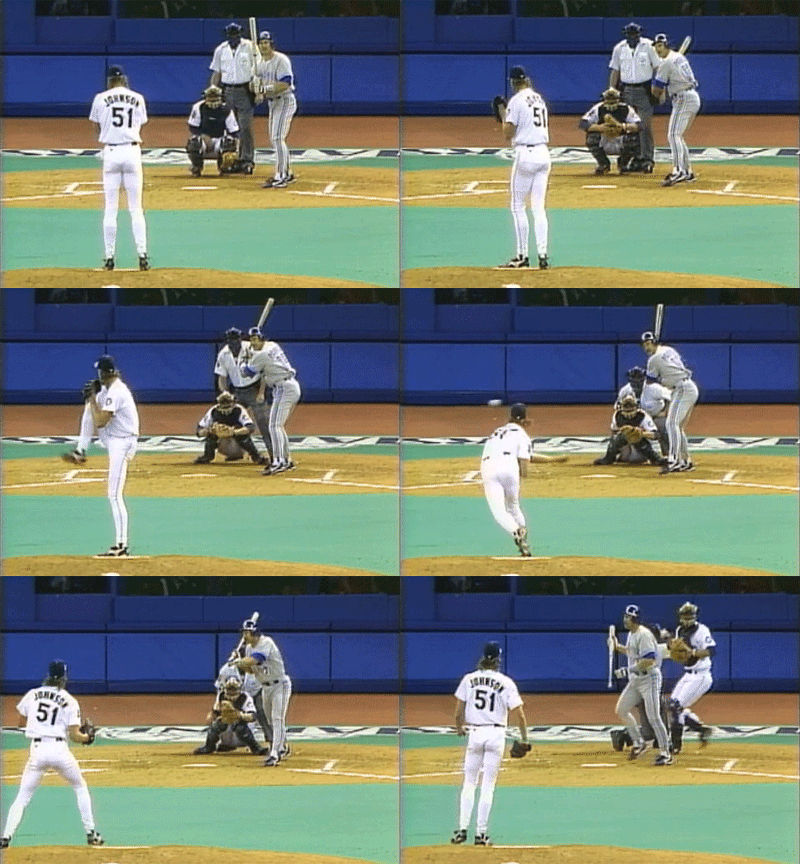
Johnson’s distinguishing characteristic was his exceptional height: at 6’10”, he was one of the tallest pitchers ever to play in the majors. His height gave him an intrinsic advantage on the mound that is often misunderstood in the mainstream. The plot thickens when one watches his delivery, as Johnson's strategy of slinging the ball from an ultra-low arm slot flies in the face of conventional wisdom, which emphasizes downhill plane. His sidewinder approach was decidedly old-school, harkening back to 12-time strikeout king Walter Johnson, who was known as the hardest thrower of his day and a tireless workhorse who personified the true “ace” label. At 6’1”, Walter was a large human for the early 20th century, and his nickname, “The Big Train,” is essentially a century-old analogue of Randy's “Big Unit” epithet.
.gif)
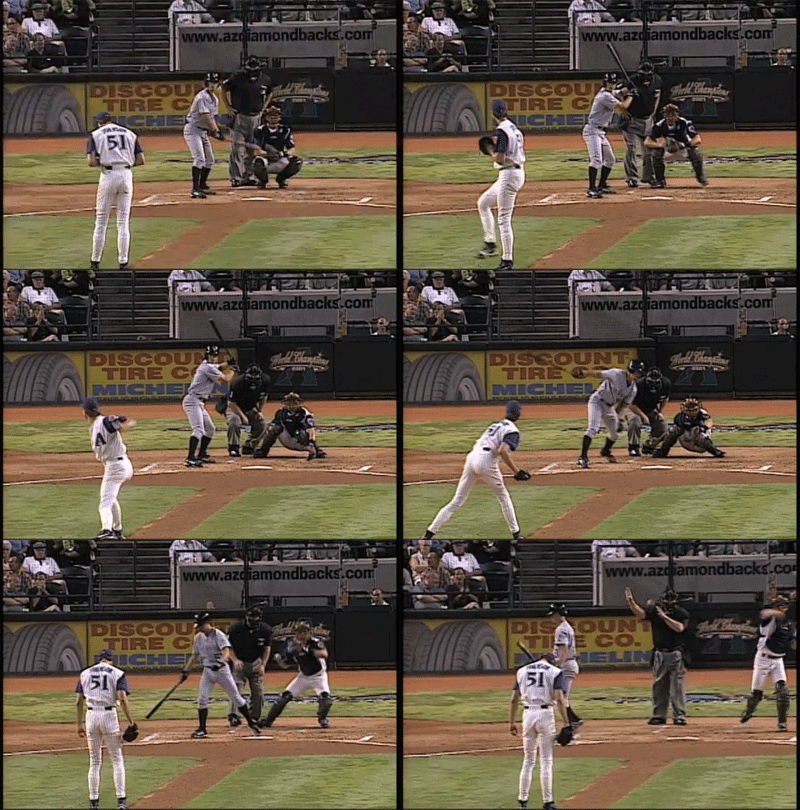
Randy Johnson's size was a tremendous asset, though the southpaw parlayed that natural advantage into an extremely deep release point, rather than one that was exceptionally high. Johnson essentially relied on just two pitches, a profile that would condemn most hurlers to the bullpen, but his ability to shrink the narrow time-window in which a batter has to recognize an incoming pitch made it nearly impossible to distinguish his slider from his high-90s heat before the hitter had to initiate a swing. Though his career did not take off until his late 20s, the lanky left-hander would end up with 303 wins and the second-most strikeouts of all-time, trailing only Ryan.
The Big Unit was not always a picture of mechanical efficiency. In the early parts of his career, he dealt with the struggles of accommodating his unique frame to a stable pitching delivery. His seasons with the Expos featured a slow delivery, one which theoretically kept his long limbs in line while at the same time opening up the door for his massive issues with timing. Johnson initially had a much higher arm slot, and inconsistent positioning before he adopted his now-trademark sidearm slot created serious control problems. The Montreal team grew tired of his act after just 10 major-league starts, trading him to the Seattle Mariners in 1989 in exchange for All-Star Mark Langston.
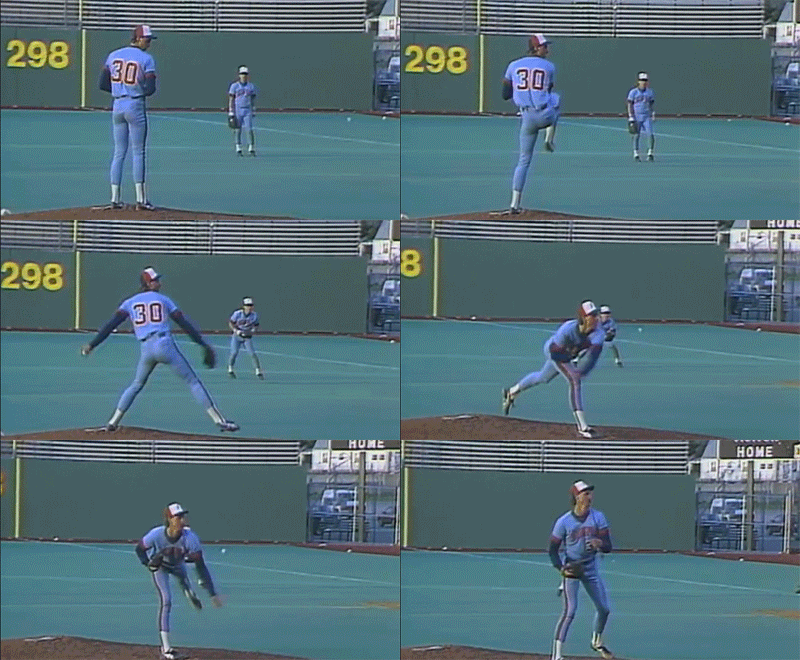
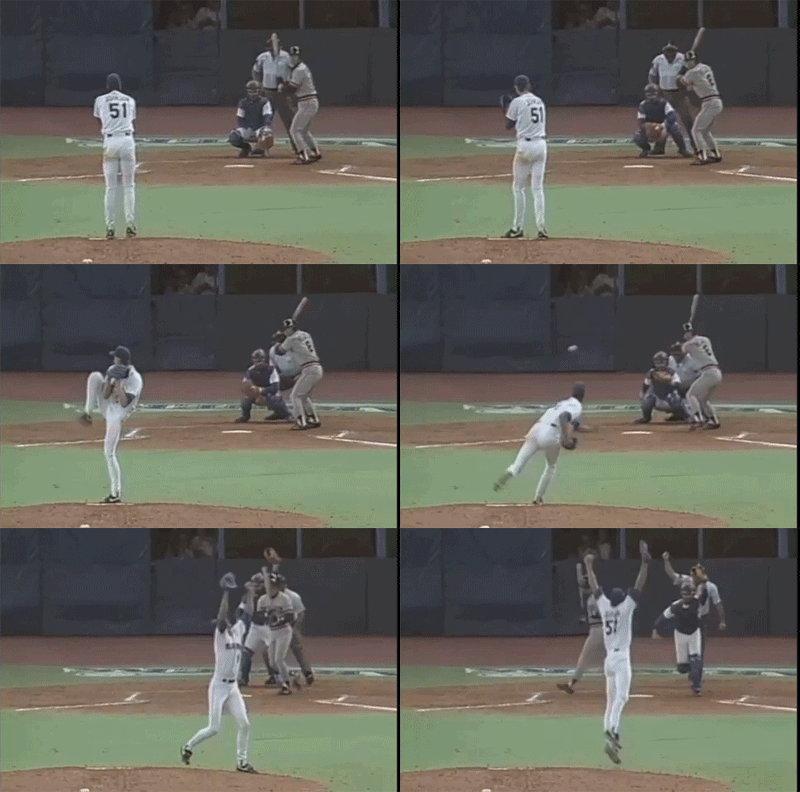
The nearly seven-foot sasquatch emerged from the Great White North and ravaged the Kingdome for the next 10 seasons. He had a rocky introduction to Seattle, walking an astounding 416 batters over 631 innings from 1990-92 and leading the league in total free passes in each of those three seasons. Johnson cranked up the ferocity of his mechanics in his early days with the Mariners, increasing his momentum and further increasing the chaos of his delivery. The strategy helped to build the Big Unit's intimidating reputation throughout the American League, though he had an even tougher time trying to contain his violent new approach enough to coordinate his delivery.
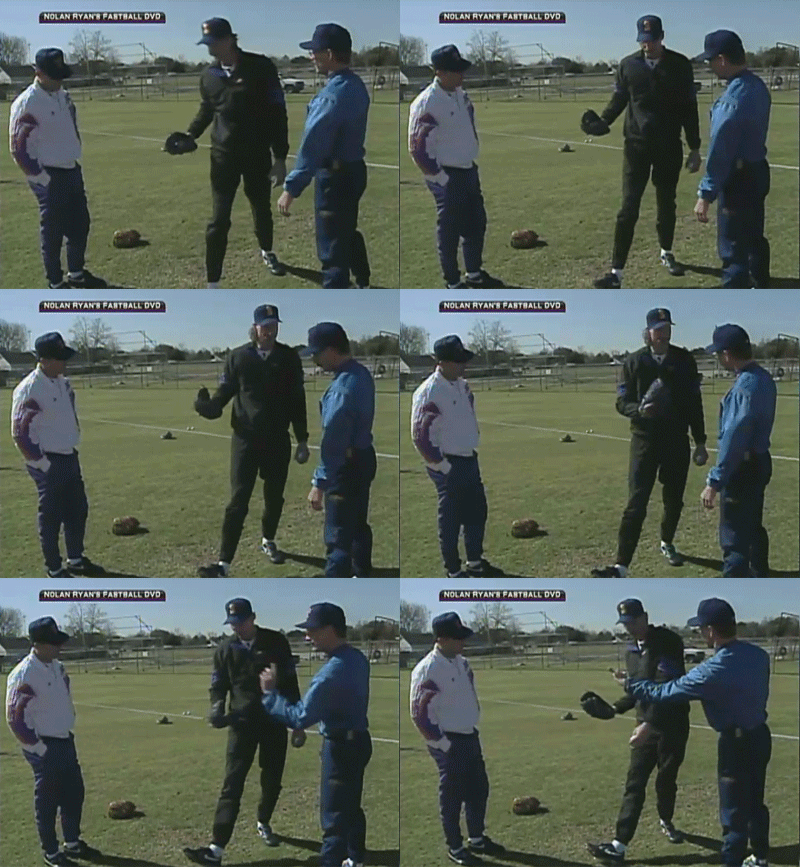
Near the end of the '92 season, Johnson began working with legend Nolan Ryan to improve his game, and Ryan brought along his pitching coach, Tom House. Johnson displayed remarkable improvement with his pitch command immediately following the tutoring sessions, striking out 45 batters against seven walks over his next three games, covering 25 total innings. That walk total was particularly impressive for a pitcher who had granted seven or more free passes in a half-dozen individual games during that 1992 season.
The lesson stuck with Johnson, as a walk rate that had hovered around 14.5 percent for his first five seasons sank to 9.1 percent for the remainder of his Seattle tenure (which was still worse than league-average). He finished in the top three in the AL Cy Young award voting four times in the that five-year span with the Mariners, taking home the trophy in 1995, before being shipped to the Astros in 1998. It was the first step in the star-laden exodus that broke up the championship-caliber nucleus of Johnson, Alex Rodriguez, and Ken Griffey, Jr in the span of just three years.
House worked with Johnson throughout the left-hander's career as he continued to hone his delivery, making improvements that were reflected in the Big Unit's extraordinary stat-line. His transition to the Senior Circuit was accompanied by a dwindling walk rate, as a mark that had floated above three walks per nine innings throughout his major-league tenure would drop below that threshold for the remainder of his seasons. Johnson attributed the improvements to a renewed emphasis on release-point distance, and given his biological advantages, the emphasis on extending his release was so effective that left-handed batters had no choice but to guess at which of his 80-grade pitches was coming. Johnson was absolutely unhittable once he learned to coordinate maximum momentum with ideal balance and perfect posture, integrating these key elements of mechanical efficiency on his way to four consecutive Cy Young awards from ages 35 to 38.
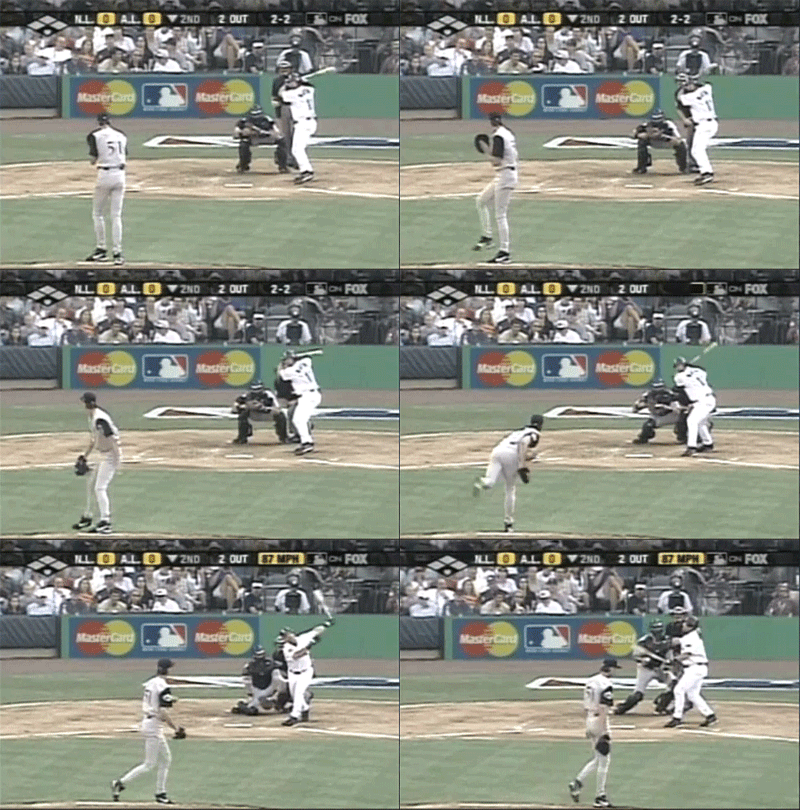
Johnson was one of the most dominant pitchers in the history of the game, and he reached his nearly unrivaled peak at an age when most pitchers are just happy to be collecting a big-league paycheck. His success was even more impressive at a time when offense was spiking across the game, but he was obsessed with self-improvement, constantly tinkering with his approach to maximize his effectiveness. Johnson's unquenchable want was apparent in his repeated phone calls to House over the years, with conversations covering a wide range of performance topics that included mechanics, approach, conditioning, and even the psychological challenges of playing ball on the biggest stage.
The Big Unit became more homer-prone as he ventured into his 40s, losing some of his trademark velocity yet maintaining his ability to put the ball wherever he wanted. He survived the harsh zoo of the Bronx before returning to the friendly confines of the Arizona desert and finishing his career with a single season in the orange-and-black. When the dust had settled, Randy Johnson had won five Cy Young trophies, secured nine strikeout titles, pitched a perfect game, and split the MVP prize for the 2001 World Series with fellow D-Back Curt Schilling.

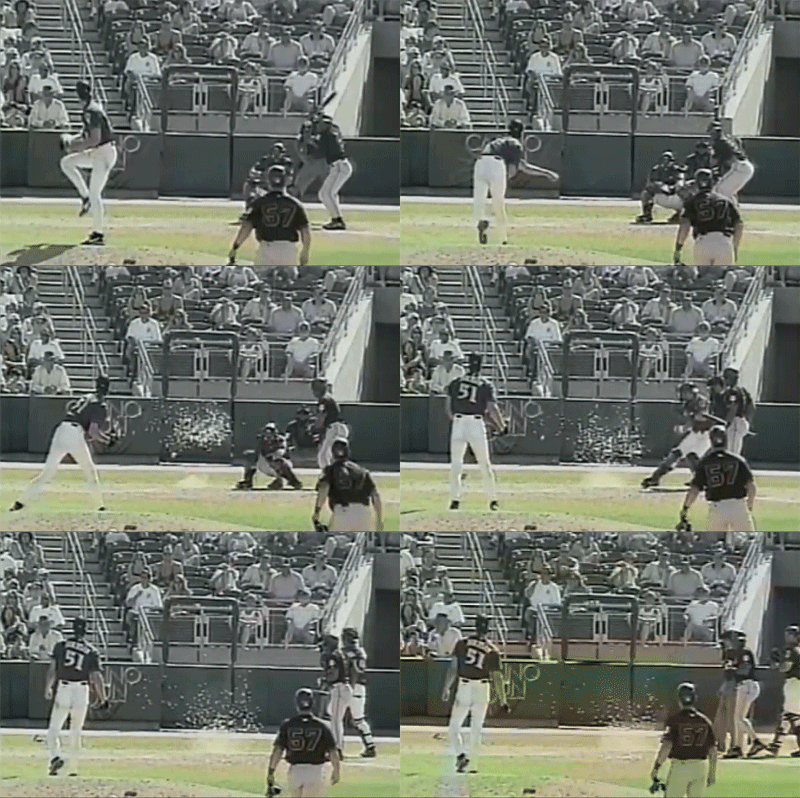
His arm was exceptionally healthy throughout his career, and back and knee issues were the only physical casualties of his extreme profile during his 22 years in the bigs. The Unit's colorful career included a half-dozen different uniforms, All-Star Game shenanigans with the likes of John Kruk and Larry Walker, a killer slider that carried the kid-show nickname “Mr. Snappy,” and an infamous exploding bird who picked the wrong time to fly through a baseball stadium.
Mechanics Report Card
|
Balance |
80 |
|
Momentum |
65 |
|
Torque |
80 |
|
Posture |
80 |
|
Release Distance |
80 |
|
Repetition |
70 |
The above grades reflect Randy Johnson's peak pitching mechanics, which were on display during his first go-around with the Diamondbacks en route to four consecutive Cy Young awards. His mechanics report card is nearly flawless, with ideal balance and posture and incredible hip-shoulder separation due to tremendous upper-body load, in addition to one of the deepest release points that the game has ever seen. His ability to maximize balance while initiating an early charge to the plate helped to further extend the giant's stride, and his functional strength and flexibility allowed him to add elements of spine flexion into his release-point extension. Johnson's mechanical efficiency was some of the best that the game has ever seen, and elite athleticism allowed him to repeat the delivery for 120 pitches per game.

The Big Unit suffered from a cranky back and balky knees, but his prized left wing was incredibly resilient throughout a 22-year career that covered more than 4100 innings. Along with Nolan Ryan, Randy Johnson represented an ideal model of how pitching mechanics can be structured to optimize performance on the field, and larger-than-life-sized pictures of the pair presided over the National Pitching Association in San Diego as reminders of the importance of emulating the hardest-working pitchers in the game. The extreme elements of size and style might serve to mask some of the ways that we can learn from Johnson's example, but the physical elements of his success can be used as a template for pitchers of all sizes.
I want to thank reader Peter Benedict for his suggestion to go back in time and review some of the great pitchers of the previous generation. Johnson is just the tip of the iceberg, and future editions of “The Good Old Days” will cover the likes of Pedro Martinez, Greg Maddux, Nolan Ryan, and Roger Clemens.
Thank you for reading
This is a free article. If you enjoyed it, consider subscribing to Baseball Prospectus. Subscriptions support ongoing public baseball research and analysis in an increasingly proprietary environment.
Subscribe now
One more idea. When you get done with your list of greats, how about studying an anti-Johnson who was also successful? I'm thinking of 1985-vintage John Tudor, who had one of the great pitching seasons in recent history without throwing a pitch above 85. Comparing him to Dwight Gooden that year, whose season was even better (barely), would be very interesting because they were so different -- left-handed extreme control soft-tosser versus right-handed flamethrower.
This series seems like the perfect way to spend the long cold nights until spring training. Thanks again for doing it.
I dig the idea of searching through the archives at mlb.com to see what I can find from the 80's, though the pickings will likely be slim. In fact, I get zero results when I type Tudor's name into the search engine.
I would also add, Sid Fernandez. Interesting for a few reasons. He managed a ton of strikeouts while never throwing hard. Also career GB/FB 0.37 and 0.247 BAbip.
I got to see Johnson pitch in Arizona on a number of occasions, including a playoff game. He left me in awe, and this article brought me back, big time. Thank you!
Of course, the ghost-arm only adds to the mythical legend of the Big Train.
That said, he would score elite marks for posture and torque, while his balance and his momentum were well above average, resulting in excellent release distance. He would likely earn 60's and above for every category, with an 80 or two sprinkled in for good effect.
Which is insane when you consider that he did this 100 years ago.
This should be a great series, Doug. Best