

When I was in high school, the thing to do was play poker. Kids would play during free periods, lunch, whenever, sometimes winning and losing over $100 in a day. (And some of them could actually afford it.) Like any high schooler worth his salt, I followed suit, and soon I was a dependably willing player, relatively conservative but always game to try to fleece a freshman who’d just looked up the rules on his expensive new iPhone. As an editor of the school newspaper, I even planted this quote in a cover story we ran on the poker fad: “It’s the most intellectually challenging thing I’ve ever done.” Yeah, when it came to antagonizing our teachers, we had a lot of tricks in our bag.
Poker may not have taught me as much as I wanted my teachers to think it did, but I did introduce me to one piece of advice that has stuck with me ever since: a successful poker player focuses more on his opposition’s holding than his own hand. I find that’s true in many walks of life, nowhere more so than in the duel between batter and pitcher, when it’s just natural to do what feels most comfortable to you, rather than what might feel least comfortable to your opponent. In the most extreme example, Aroldis Chapman walks a Little Leaguer on four sliders because he fears he doesn’t have his best heat that day. In a real-world example, the Yankees don’t adjust to the way their ALCS opponent’s pitchers attack them, and their season ends because of it. (Oh, and Justin Verlander somehow allows a home run to Eduardo Nunez. But we’ll get there.)
Most of the Yankees’ hitters—Alex Rodriguez, Robinson Cano, Curtis Granderson, Mark Teixeira et al.—are used to holding all the cards; that is, they’re used to actually being good hitters. (Despite his recent decline, Rodriguez especially looks like someone who has been dominant for so long that he can’t cope with a lesser skill set. That’s how all those missed fastballs make it seem, anyway.) This postseason, for reasons that defy explanation, the Yankees weren’t good hitters. To a certain extent, there isn’t much you can do about that. Joe Girardi repeatedly stated during the ALCS that his hitters didn’t adjust, as managers love to lament when their stacked lineups don’t deliver. While that’s true, the necessary adjustments should lie as much in reading the opposition’s game plan—which seemed tailored toward going after weaker hitters rather than respecting feared ones—as tinkering with one’s hitters’ own swing mechanics.
The Yankees are famous for working the count. That’s why Yankees-Red Sox games, the ones that are supposed to represent Major League Baseball’s marquee rivalry and the very best baseball a fan could see, are actually unendurable, four-hour dirges. Well, working the count is a great plan when you’ve got the most potent lineup in baseball, but when nobody can remember his last hit, it seems like a recipe for 0-2 count after 0-2 count. The Yankees struck no fear in anyone, and the Tigers showed none.
Take Game One, for example. By the sixth inning, the heart of the Yankee order was coming up for the third time against Doug Fister, who was anything but unhittable, allowing six hits and four walks over 6 1/3 innings. In an unbelievable streak stretching from the sixth to the eighth inning, 11 consecutive Yankees took first pitch strikes.1 Eleven! Keep in mind, this wasn’t the beginning of the game—five of those 11 batters were coming up for the fourth time against the same pitcher, down by two runs, and still weren’t ready to hit him. Fister took advantage, getting himself ahead in the count and prolonging his outing a few outs longer than his pure stuff probably deserved.
It would be unwise, of course, to assign all the blame to the Yankees—after Fister and Jose Valverde’s blown save later that evening, the Tigers’ pitching was utterly dominant. So let’s take a look at an example of one Tigers pitcher who read the opposition’s hand perfectly, and one whose failure to do so was conspicuous in contrast to his incredible performance to that point.
***
In Game Three, Justin Verlander was as smothering, aggressive, and dominant as you’d expect him to be against the flailing Yankees. In the smallest of sample sizes, Verlander’s three strikeouts and no walks were telling—facing a lineup in such an epic slump, Verlander wasn’t afraid to pitch to contact and let his big ballpark and solid outfield defense produce 14 fly ball outs over 8 1/3 IP. He allowed three baserunners, one of whom made it past first base, and retired 18 of his first 19 batters faced. It was the kind of outing where you expected Verlander to stalk off the mound, doff his cap at the crowd, wave his arms in the air and maybe dangle a Kate Upton centerfold towards the Yankee dugout.
Maybe that’s not in his personality—maybe Kate finds his modesty attractive—but instead Verlander looked a little defeated, almost trudging toward the clubhouse, offering a sheepish wave to the crowd as he greeted his teammates. He had a lot to be proud of, but he wore the look of a man who’d just been burned by Eduardo Nunez.
I’ve harped on this topic before in this space, but there’s a philosophy specific to a late-game, two-run lead that managers impress upon their pitchers. Basically, you can’t walk anyone and let your opponent bring the tying run to the plate. With many exceptions, of course, this leads to mixing in a few more fastballs on average. And Jim Leyland shouldn’t have had to tell Justin Verlander to mix in a few more fastballs, especially not when a) he couldn’t be that tired, with his fastballs to Nunez averaging 98.6 mph, and b) he unleashed a 97-mph first-pitch heater right down the pipe that beat Nunez, who fouled it off.
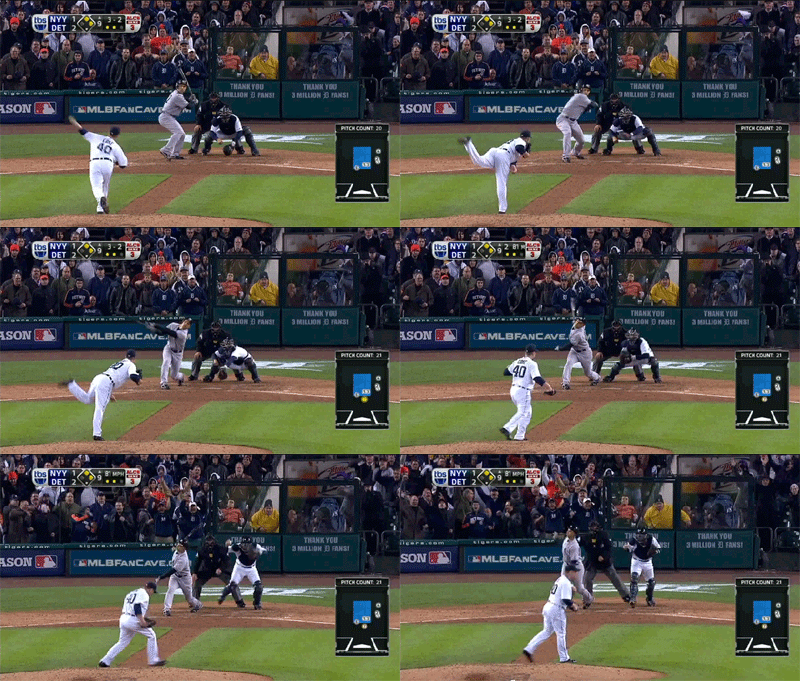
In a rather bizarre sequence, though, Verlander’s next five pitches were off-speed; four of the five were sliders, two of which were fouled off sharply, while the fifth was a bad curveball in the dirt that Nunez took for ball one. Especially telling was the 0-1 slider, where to my eye Nunez appeared geared for another fastball but found that his bat speed was actually better suited to this 88-mph slider:
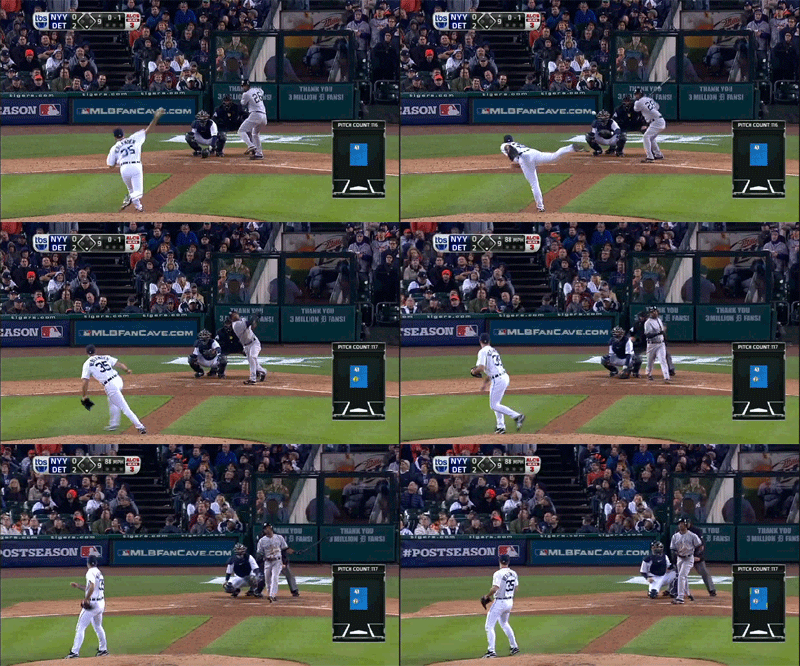
(Note: You may disagree that Nunez was “geared” for a fastball there. I say he was for two reasons: first, he was facing Verlander and had just been late on 97 mph, and second, that’s just what his swing looked like on that pitch, to my eye. There was absolutely no knee-buckle or adjustment of any kind; he was gripping and ripping, just as he was on the first pitch.)
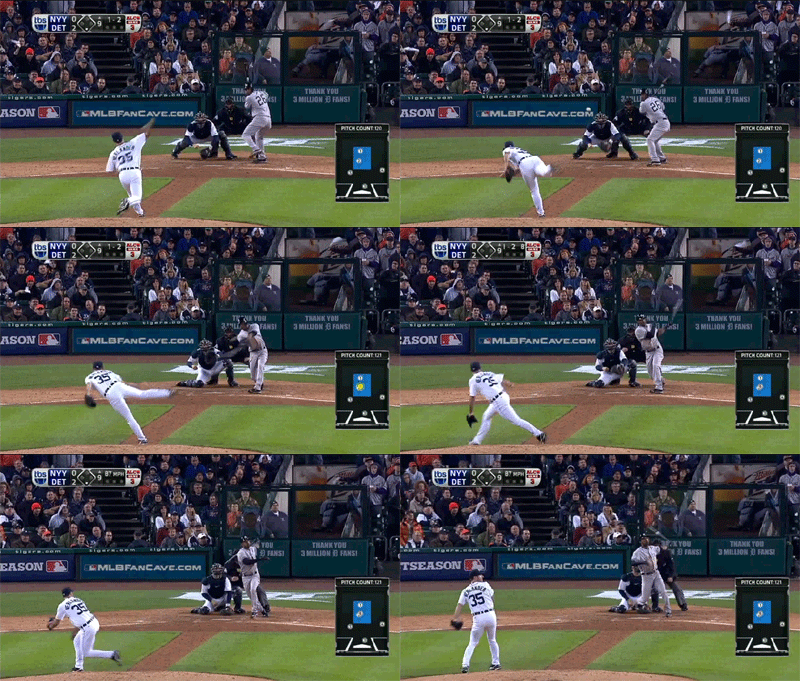
On the sixth pitch of the at-bat, Nunez came close to an extra-base hit off another center-cut Verlander slider, but again he couldn’t quite keep it fair:
Verlander finally went back to the fastball on 1-2 but wasted the pitch (not to be confused with a “waste pitch”), missing low. On 2-2, Nunez was late on another fastball, fouling it away. Then, again on 2-2, Verlander inexplicably came in with a curveball; it was his fourth terrible off-speed pitch of the at-bat, right over the heart of the plate, and even Nunez couldn’t miss it a third time:
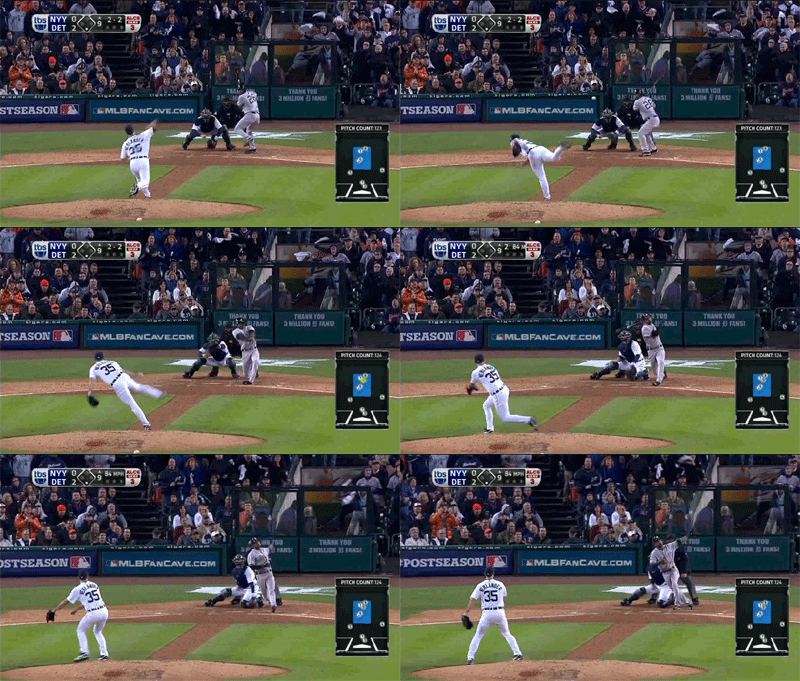
It’s not that Verlander should have killed his off-speed stuff with a late-inning, two-run lead, but it wasn’t working and the batter had given him every reason to throw the fastball, so another curveball was a strange decision, to say the least. Nunez hadn’t caught up the fastball all night—earlier in the game, he had flown out to right and grounded out to first on fastballs. Verlander was throwing his heater harder than ever at that point in the game, he’d failed to execute his breaking stuff on multiple occasions prior to the homer, and was a cold, rainy night in Detroit, with the wind blowing in. It was a dour conclusion to an otherwise typically brilliant outing.
***
Fortunately, Verlander had Phil Coke to show him how it’s done. (There’s a sentence I never thought I’d write.) Coke has played a prominent role in the postseason and was once again deputized as the Tigers’ closer in Game Three, entering in relief of Verlander. He retired Ichiro and gave up a soft single to Mark Teixeira before making perhaps his worst pitch of the series, leaving a fastball over the middle for Robinson Cano, who couldn’t help but end his postseason record 0-for-29 streak with a sharp single to left. That put the go-ahead run on base with two outs for glory-hounding Raul Ibanez, whom Girardi elected not to replace with a righty.
Coke has shown a lot of confidence in his curveball this month, but he threw just two curves in 21 total pitches in Game Three, including a sharp first-pitch bender to curb Cano. Against Ibanez, Coke elected to come down the line with six consecutive fastballs; the first two missed away, and after a foul ball on 2-0, Coke missed away a third time to fall behind 3-1. In a fastball situation, Coke left another fastball right down Broadway, but Ibanez squandered his chance, fouling it off to run the count full. “Does he have the guts to go with a 3-2 slider, or is he going to go with the fastball?” asks TBS analyst John Smoltz. “These are big moments.”
Take a look at the pitch locations here. At this point in the at-bat, Ibanez had seen five fastballs, all middle-away; three were outside for balls, while the other two were down the middle and ever-so-slightly away—Ibanez was late and fouled them away. A hitter has to slow himself up a few extra milliseconds on fastballs away, because in order to really drive those pitches, he has to hit them to the opposite field. In a vacuum, this makes him somewhat less susceptible to the off-speed pitch. There are other factors in play as well: Ibanez’s lateness on the two foul balls suggested that his bat might have been calibrated a little slower, and after five pitches middle-away, Ibanez may have been likely to be leaning out over the plate, ready to hit any pitch in that area. And do I need to mention that ball four would have put the go-ahead run in scoring position?
No, Coke didn’t want the curve just yet, but he did throw a pitch Ibanez hadn’t seen: a fastball inside.
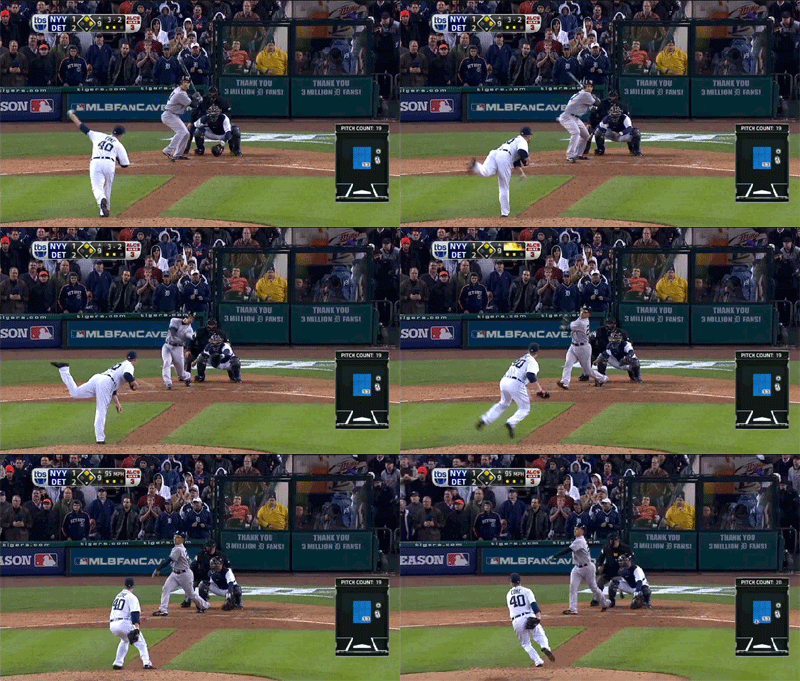
Ibanez pulled it foul. This changed everything. Now the pitcher had recalibrated the hitter’s bat; Ibanez was now actually ahead of the fastball. With all the circumstantial factors swung in his direction, Coke could make the gutsy call, and his hellacious 3-2 curve got Ibanez to end the game.
Tigers catcher Alex Avila deserves some credit for that call as well—it’s tough to imagine any pitcher, let alone Phil Coke, shaking off a fastball in that situation.
You can never boil a matchup down to one variable, one thing a guy did right or wrong that determined the outcome of an at-bat or a series. The Yankees’ bats went unfathomably cold, which likely sealed their fate, but the first three games weren’t blowouts. Maybe more mistakes like Verlander’s or fewer gutsy moves from Coke and Avila could have swung one or two of them. And the longer the series went, the more time the Yankees would have had to get their bats going, and then…who knows. Kudos to the Tigers for not giving them that chance.
1 Eight were from Fister, and three from reliever Phil Coke, with Fister’s eight including four consecutive first-pitch off-speed pitches, all in the sixth inning, that went unrecognized as a pattern. The streak also counts a meaty hanging slider from Fister that Nick Swisher took for ball one; PITCHf/x recorded it as clearly within the strike zone, and casual observers recorded it as “should’ve been a home run.” I thought it was fair to include that, since it was another hittable pitch going by the wayside.
Thank you for reading
This is a free article. If you enjoyed it, consider subscribing to Baseball Prospectus. Subscriptions support ongoing public baseball research and analysis in an increasingly proprietary environment.
Subscribe now